The King is dead. Long live the king.

The so-called King of all asanas aka salamba sirsasana aka supported headstand is one of the crowning achievements in yogasana. If you can perform headstand, you join an elite group of yogis. If you teach it, especially to a group of wide-eyed beginners, you are a yoga rock Goddess. Another teacher once bragged to me that, within some period of time (months? a year? I can’t recall), every student in her class was able to perform sirsasana. I taught it at one time too. Before I had any business teaching it. I continued to teach it after I considered myself qualified. What qualified me? The usual stuff – I regularly practiced it. I read and watched tutorials on the internet and in books. I learned from other teachers. I took a couple of workshops.  I taught headstand because I craved the status. I desired to impress. I delighted in being responsible and lauded for another person’s accomplishment. I never wanted to hurt anyone. I’d like to say that I didn’t hurt anyone. But I don’t know. There were no reports of injuries. But, then again, I’ve had students confide in me about injuries sustained in another yoga class, including one suffered from prep work and attempts at headstand, but these students never told the other teachers.

But here’s the thing. I thought that if I followed the cumulative wisdom of alignment in headstand that I, and anyone I taught, would be safe from injury. I thought that if I drilled the shoulder girdle prep work into my students ad nasueam (lift your shoulders! lift your shoulders! lift your shoulders!) and dampened my enthusiasm and that of my students by  patience, restraint, and slow, methodical prep work, it would be all good. I was wrong. I liken this King of all yoga poses to King Henry VIII, known for many things, but most notoriously for lopping off tens of thousands of heads during his reign. Nobody knows how many heads have been lopped off by King Sirsasana, because nobody is counting. OK, nobody has literally lost her head with this pose, but we do know that adverse events can and do occur with headstand and that they can be of a serious, life altering nature.

Here is what’s been written up  over the years in case reports in the medical literature and captured in a 2013 review article entitled Adverse Events Associated with Yoga: A Systematic Review of Published Case Reports and Case Series. Keep in mind that this is not an inventory or accounting of the actual number of adverse events caused by yoga. These are the very few cases, where someone experienced an injury or other adverse event directly attributable to yoga; and where that person was seen by a physician, who subsequently wrote about the event and published the case in a scientific journal. What is missing from the number of cases reviewed (76) are the potentially millions of injuries/adverse events that occur each year in the US alone, where over 15 million people practice yoga and pranayama regularly. There is currently no way of knowing how many of these events occur each year because studies large enough to provide a valid estimation have not been done. In the above review of cases, headstand was culprit in 10 of the 76 cases.

Adverse events attributable to headstand included:

  • Worsening of vision secondary to glaucoma; this 46 yo female yogi fully recovered in several months by avoiding sirsasana
  • Progressive pigmentary purpura – a rusty brown skin patch caused by leaky capillaries (tiny blood vessels) of the forehead; the treatment was topical corticosteroids and the clinical outcome for this 59 yo male was unclear
  • Bilateral orbital varices (bulging veins in the eyes) due to increased blood flow;  treatment and clinical outcome were unclear for this 62 yo female
  • Basilar artery occlusion aka a stroke; the 34 yo female yogi received inpatient treatment and physical therapy  and had not fully recovered one year later
  • Progressive optic neuropathy (nerve damage to the eye) secondary to glaucoma; the course of treatment and clinical outcome for this 46 yo female were unclear
  • Bilateral conjunctival varix thromboses or enlarged veins with blood clots in the eyes; the 60 yo male yogi had a surgical excision of the blood clots but the clinical outcome was unclear
  • Progressive optic neuropathy (nerve damage in the eye) secondary to congenital glaucoma; the treatment and clinical outcome for this 47 yo female yogi was unclear
  • Early glaucomatous optic disk change and visual field loss aka pathological changes in the eye accompanied by worsening vision; treatment for this 29 yo male yogi was avoiding inversions, which stabilized his eye status
  • central retinal vein occlusion aka eye stroke; this 55 yo male yogi underwent eye surgery, but did not recover

If I had glaucoma or a family history of glaucoma and a yoga teacher cued headstand without detailing why it would be contraindicated for someone with glaucoma, I would walk run, possibly screaming, from the room because at the very least,  teachers should know this universally agreed upon contraindication. I cringe to say it, but I’ve been in many yoga classes, where headstand was cued, but few of them came with warnings about headstand’s potential effects on glaucoma, detached retina’s, neck issues, or uncontrolled blood pressure. And then, confounding matters and tarnishing the shine I feel when I call my teaching style “Iyengar-influenced,” there is this, from B.K.S. Iyengar from his seminal work, Light on Yoga: “I have taught this pose to a lady of 65 who was suffering from glaucoma. Now she finds the eyes are completely rested and the pain in them is much lessened. Medical examination revealed that the tension in the eyeballs had decreased. I am mentioning this to prove the value of the correct head stand.” One could not be faulted in believing that a good teacher can align the bad away in sirsasana, even though numerous case studies, as well as full research studies, show that intraocular pressure rises in headstand and exacerbates glaucoma.

While I have a macabre fascination with headstand-induced strokes and vision loss, my real interest lies in the biomechanics of sirsasana and potential or actual musculoskeletal injuries to the cervical spine.The weight of an average adult head is 7.5% of total body mass. Your cervical spine was designed to carry the weight of your head, or about 7.5% of your total weight. In headstand, as you will learn later, you ask your neck to bear upwards of 50% of your body’s mass. For example, I weigh 125 lbs, so my head weighs about 9 lbs. Thus, my neck has a loading history of hauling around 9 lbs give or take a hat. However, when I perform headstand, I potentially place more than 60 lbs of weight onto my cervical spine, which, again, has a loading history and capacity of 9 lbs or less. Vertebra are made of trabecular bone, which is the spongy variety and more prone to fracture. Loading beyond tolerance levels subjects your neck to the possibility of a burst fracture. Burst, in case you need reminding of its definition means “to break suddenly and violently apart, spilling the contents, typically as a result of an impact or internal pressure.” Not something you want associated with your neck. But a more likely scenario, detailed below, is the possibility of spinal cord compression by a compromised cervical spine.

What I found remarkable about these cases was that none is the type of musculoskeletal injury you might expect to find when you  hold the majority of your body weight on the fragile vertebrae of your neck. To an emergency room physician or orthopedic doctor seeing a headstand-related neck injury, it’s going to be a no-brainer. A neck injury, where you might expect one, is neither as fascinating nor case-worthy as, say, a pneumothorax (collapsed lung) caused by Kapalabhati or breath of fire. So, I went searching and found a few case studies that were not included in the 2013 review article. In one case, a 63 yo woman, who had practiced yoga for 30 years and had a daily headstand practice, presented with bilateral hand numbness. Imaging showed severe multilevel degenerative disc disease, spinal stenosis (narrowing of the spinal canal in which the spinal cord runs), and secondary compressive myelopathy with myelomalacia  aka compression of the spinal cord by the vertebrae. In another case, a 63 yo man presented with history of tingling & numbness in his finger and toes, weakness and stiffness in all four limbs, and frequency and urgency of urination. There was no history of trauma to his neck or back. For 25 years prior, he had done headstand daily. He, too, was found to have cervical compression of his spinal cord. While case studies are captivating, they don’t tell us that much. What I needed was a research study. What I found, was even better. I uncovered a Master’s Thesis completed in May 2012 by Rachel E. Hector from the University of Texas, Austin, entitled Sirsasana (Headstand) Technique Alters Head/Neck Loading: Considerations for Safety. I could not have dreamed of a better find.

Here is how the study played out. Three groups of 15 yogis practiced one of three variations of sirsasana. Variations occurred in the entry and exit  from the postures, while the actual holding of the headstand was the same for each group. Group 1 entered and exited sirsasana by lifting/kicking one leg up at a time; Group two bent both knees, then straightened them together; Group 3 extended both legs and lifted symmetrically, in a pike position. I present a sketch of the entry techniques from Hector’s thesis.

Three ways to enter/exit headstand

Three ways to enter/exit headstand

Participants performed their respective variations, holding for 5 breaths, while a force plate beneath them measured peak forces acting on the head and neck, loading rate of those forces, center of pressure, and neck angle in the frontal plane at C3 (cervical vertebra 3). The study study examined the weight-bearing responsibility of the head and neck – separate from the arms, which I found to be a critical parameter. You can read Hector’s thesis to learn how they rigged the force plate to eliminate interference by arm forces.

Highlights of the study revealed:

  • the average yogi loads the head with 30-50% of his or her body weight while performing headstand
  • Individuals entering the posture with legs extended and together (pike position) exhibited the lowest maximum and average forces during entry with over 75% of participants using this technique staying below the threshold of vertical loading known to cause cervical failure (image on far right)
  • Individuals entering the posture by lifting/kicking one leg at a time experienced the greatest forces on the neck, with more than one half of them experiencing forces above the loading threshold for potential cervical failure (image on far left)

If headstand is responsible for an unknown number of strokes, vision loss, and debilitating damage to the cervical spine, why is still practiced and taught in most yoga studios? I think the reasons can be complex and beyond my ability to articulate nuances of empowerment, sacrifice, injury, and redemption in yoga. The courageous, thoughtful, and frankly brilliant Matthew Remski, the most compelling writer on philosophical aspects of yoga injuries, explores these ideas in his heady WAWADIA Project . I can not recommend it enough. I’ll go further, you should pre-order a copy of his soon-to-be-published-but-not-soon-enough book (which was crowd-funded, no less), because it’s first printing will sell out.

While Matthew wades through the deep stuff, I’ll pluck the low hanging fruit and merely bullet a list of popular, but mostly unexamined, “medical” benefits of King Sirsasana, tidily summed up in this giddy, optimistic article 10 Awesome Medical Benefits of Headstand. Fortunately, there are practitioners out there like Dr. Kathleen Summers, another yogi doc, who writes in a fairly balanced three-part post about the purported benefits of sirsasana and some potential dangers,  addressing several of these claims.While some of them are reasonable and may be valid, most are unexamined. My comments are in brackets.

The 10 [so called] Medical Benefits of Headstand

  1. Relieves stress [possibly for some; for others, it will likely increase stress hormone secretion]
  2. Increases focus [definitely]
  3. Increases blood flow to the eyes [yeah, that thing about glaucoma]
  4. Increases blood flow to the head & scalp [uh, no; the body has a highly regulated, secure system that will not throw the brain under bus for folly or whim]
  5. Strengthens shoulders and arms [yes and yes; in fact, Dr. Loren Fishman, a world-renowned rehabilitation physician and long time yoga practitioner and teacher, in a small pilot study (10 participants), produced remarkable results using sirsasana and even sirsasana prep work to heal torn rotator cuffs.]
  6. Improves digestion [huh? what? digestion is a downward action; human physiology is designed to push food, urine, feces, menstrual blood, and babies down and out; this makes about as much sense as having a delivering mother stand on her head to improve the birthing process. Ugh.]
  7. Helps flush out the adrenal glands [really? please elaborate]
  8. Decreases fluid build up in the legs, ankles & feet [yes, it will increase venous blood return, but only while you are in the pose]
  9. Develops strength in the core muscles [yes; this is more likely with a controlled pike variation of entry and exit; but while stabilized in headstand, the same alignment applies as in Tadasana – neutral pelvis and ribs to bring the core musculature to its appropriate length for maximum force generation]
  10. Stimulates the lymphatic system [yes, but a better, safer way to stimulate your entire lymphatic system is whole body movement such as walking in alignment.]

When these master-blessed messages are perpetuated in books, magazines, videos, websites, and by a staggering number of teachers in countless studios, then you have potentially hundreds of thousands of people clamoring to honor the King, without a clue that sirsasana can be a very nasty ruler indeed. While it is possible to suffer a musculoskeletal injury in just about any yoga pose, the stakes for musculoskeletal AND other adverse events like stroke and vision loss are higher than most would be willing to wager – if only they knew.

So, I end by circling back around to the work of Rachel Hector (who, by the way, recently published her findings in the Journal of Bodywork and Movement Therapies) and leave you with my recommendations, based on her work, for practicing sirsasana – IF you still feel compelled to practice it. But first, let me be very clear about some contraindications and caveats.

Contraindications:

  • If you have glaucoma or uncontrolled blood pressure, do not practice sirsasana
  • If you have low bone density in your spine, do not practice sirsasana
  • If you have degenerative discs in your spine, do not practice sirsasana
  • If you suspect that sirsasana is injuring you, do not practice sirsasana
  • If you feel pressured by teachers, students, media, or your own ego to practice sirsasana, do not practice sirsasana
  • If you are 35 of older (the age range with the highest risk for disc degeneration), do not practice sirsasana, and if you do, do not practice it daily. While Hector’s study did not find age to be a factor (her study subjects ranged in age from 18-60), intervertebral immobility and disc degeneration come with aging. Large, repeated, asymmetrical loading onto immobile, degenerative cervical discs that are not designed to withstand 50% of your body weight can, as the cases studies highlighted earlier, cause cervical failure resulting in neurological damage to the spinal cord. This damage is cumulative. You may not know its happening until one day, you know it’s happened.

Caveats:

  • According to Hector’s study, the taller you are and the more you weigh, greater are the loading forces and loading rate applied to your neck
  • Men tend to have higher loading rates and maximum forces on the cervical vertebrae (largely explained by their greater weight), however, studies on male cadavers have consistently shown that males have a much greater loading capacity before cervical failure occurs. Are you one of the lucky ones?
  • The subjects in Hector’s study ranged in yoga and headstanding experience from 6 months to 20 years and that experience was not a predictor of any outcomes. It bears repeating: headstanding experience was not a predictor of any outcomes. Experienced headstanders, with as much as 20 years experience, had no added protection from negative cervical spine outcomes. This was the most surprising result of the study and possibly the most important to the yoga community. There is a perception that if you get hurt in yoga, it is your fault, that you were novice, or not practicing good alignment, or you weren’t ready for the asana you were attempting. Matthew Remski, once again, illuminates these perceptions brilliantly in a piece on headstand that inspired me to begin consideration of its risks. The darker side of this coin is that if you are experienced and in good alignment, you might think you won’t get hurt. But in reality, being experienced at headstand may not protect you and being inexperienced may not put you at greater risk for injury. I can’t quite wrap my headstand head around this, but it bears consideration.

Recommendations for practicing Sirsasana:

  • Enter with legs extended (no bend in knees) and lift, symmetrically, in a controlled manner. This method of entry measured the least amount of forces to the neck and occurrences of sudden changes in loading, as it loads the head and neck slower than the other methods. This method of entry requires more intense upper body activation and controlled loading – essentially a better strength to weight ratio that kicking one leg up at a time.
B.K.S. Iyengar in Sirsasana

B.K.S. Iyengar entering sirsasana

  • Exit the pose quickly, by allowing one leg to drop to the mat in a controlled manner. This method of exit, as opposed to the pike exit, appears to reduce over-flexion of the cervical spine upon exit. Flexion-compression, also called pre-flexion or axial loading, loads the cervical spine without is natural curve and is the most vulnerable configuration of spinal alignment, which can result in spinal injury due to buckling failure.

The king is dead. Long live the king.

Namaste, Michele

When alignment points are biomechanical

After my first yoga class with an Iyengar-certified yoga teacher, I was hooked. The  placement of body parts at precise distances from each other, the bewilderingly colorful cues like “pull your skin up from your heels to your waist,” the blankets, and bolsters, and straps, oh my! Increasingly nuanced alignment combined with meditation-inducing long-held postures resonated like no other practice I had experienced. And, later, as a teacher, those unwavering alignment cues provided me a hook, something to cling to, in those first years months, when I hadn’t a clue what I was doing or talking about in yoga.

In the intervening years,  I’ve learned muscle anatomy – which muscles are contracting, stretching, and stabilizing in which yoga poses from smart guys like Ray Long. I’ve been exposed to passionately informed writings on the latest research in stretching and muscle physiology via the likes of Jules Mitchell. I’ve dabbled in the writings of the great Tom Myers on the endlessly fascinating and surprising subject of fascial tissue; practicing and teaching in the style of those who try to apply this evolving fascial knowledge to the Yin style of yoga, namely Paul Grilley, Bernie Clark, and Sarah Powers. All of these body thinkers school and inspire me and are constantly confirming and opposing each others wisdom. It’s maddening! Enter the fray Katy Bowman. She updated my understanding and practice of Iyengar’s culturally-based yoga alignment with an alignment based in geometry, physics, and engineering. Her circular theory, via her Restorative Exercise™ program, goes something like this:

There is one position of the body that ensures optimal flow of electricity (nerve impulses), blood (oxygenated cell food), and lymph (cellular waste removal). This position also happens to minimize friction in the joints and compression in the vertebral discs. Using 25 bony markers to align joints relative to each other, and in the case of multi-articular joints like the spine, relative also to itself, you place your muscles in the optimal position for strength and yield, which equals the greatest amount of electrical flow, which equals the greatest amount force generation, which equals the greatest amount of blood flow to those muscles. The greatest amount of blood to the tissues equals the greatest amount of tissue regeneration. Tissue regeneration equals tissue health. Biologically speaking, our bodies have one, and only one job, and that is to make cells. Our muscles must be at the correct length for strength, yield, flow, and ultimately cellular regeneration. It is through alignment that we get our muscles to the correct length and so goes the circle.

What I like about Katy’s alignment markers is their universality. Everyone is distinctly shaped and sized but can use the same markers because the bony points are yours and are relative to yourself. This is infinitely more objective and discriminating than cues based on distances. To ask a class of 20 differently shaped/sized students to “jump your feet four feet apart”  is not an appropriate cue for most of the bodies in the room. My “four feet apart” at a height of 5’8 is going to look and feel very different from someone who is 5’1, who is going to look/feel very different from someone who is 6’4. The RE alignment points are based on Katy’s understanding of muscle force length or the length-tension relationship, whereas cues in the Iyengar  style, and subsequently most styles of yoga practiced in the US, were developed for another culture with different tissue loads, anthropometric dimensions, and very specific environments that are quite different from the way most Westerners spend their waking (and sleeping) hours.

So, have I abandoned Iyengar altogether? Absolutely not. My copies of Light on Yoga: Yoga Dipika and B.K.S. Iyengar Yoga: The Path to Holistic Health are dog-eared and consulted anytime I want to reference how the man, who is arguably responsible for the way Hatha yoga is practiced in studios worldwide, cued and presented a posture. But then, I use my filters of current body thinkers and that of my own body experience to update what I practice and teach.

Namaste, Michele

Who is this Katy Bowman and why is she such a disruptive technology?

I am studying to be a Restorative Exercise Specialist™ with Katy Bowman. Katy started out studying mathematics, switched to physics, and finally landed on biomechanics, which is the study of how mechanical principles (forces & loads) affect living structures like the human body. After completing her undergraduate degree in biomechanics, she worked for 10 years in the fitness industry as an instructor and trainer of many different exercise modalities. She then returned to school to complete a masters degree in biomechanical engineering, where she pursued her growing interest in cellular biomechanics. This mixing of her academic knowledge in geometry, physics, engineering, physiology, and anatomy with her experiential knowledge of fitness and movement psychology makes a powerful brew of whole body health and provokes a radical departure from fitness as we have known it. I am endlessly fascinated, mind-boggled, maddened, challenged, and always entertained by her brilliant, down to earth treatment of and conviction about whole body health and wellness. My studies with Katy have transformed my body, my yoga practice, my teaching, my house(!), and my movement choices in unexpected, enduring, completely satisfying ways.

I am excited to be in the review phase of this program and at a place, where I feel a bit more confident sharing my understanding of Restorative Exercise™  aka RE, which is not a movement program, but a living program that emphasizes all day, everyday, aligned, natural whole body movement. Topics in upcoming posts during this review phase will be about fitness/exercise, cardiovascular health, blood physics, muscle physiology, alignment points, movement nutrition, mechanotransduction, walking/gait, squatting, casting, breathing mechanics, osteoporosis,  and individual areas of the body – knees, hips, shoulders, etc.; oh, and feet of course!

**Because I work in the yoga world, I need to make a clarification. Restorative Exercise™ is not restorative yoga in any way, shape or form. The RE name is an unfortunate, confusing choice for those of us who also happen to be yoga instructors. Sigh.

Learn more about Katy Bowman and RE.

Namaste, Michele

Sleeping on a mattress is the new sitting

There are people out there that eschew the comforts of mattresses, choosing instead to sleep directly on the floor with minimal padding. I am one of them. Different sleeping surfaces create different loads to your body’s tissues. Loads experienced from a soft squishy mattress will be entirely different from loads experienced, when forces applied are from a firm mattress, futon, camping pad, or ground tarp. One can apply the analogy of footwear to sleeping surfaces. Heel height, toe box size, upper robustness, and sole rigidity/thickness can unnaturally load your feet to varying degrees. Shoes put unnatural forces on  your feet and among many other things (alignment, walking/standing surfaces, amount and repetitiveness of movement, etc.), are implicated in poor foot mobility, flexibility, and strength and in many foot maladies including plantar fasciitis, bunions, metatarsalgia, Morton’s neuroma, etc. The tissues of your shod feet would respond one way to constantly running on flat, unvarying, hard asphalt/concrete and another way completely to walking barefoot or minimally shod over natural terrain with its rocks, roots, divots, sand, water, prickles, grass, moss, sticks, and inclines. Your bed is the unnatural equivalent of a flat, hard surface for your feet with its attending maladies. Sleeping on a minimally padded floor or the naturally padded earth is like walking barefoot in nature, with its ensuing health benefits.

My teacher, biomechanist Katy Bowman’s concept of casting comes into play with mattresses. She describes casts/casting as the habitat in which we dwell that prevents full use of our body. Obviously, shoes and flat walking surfaces are casts, because they keep us from using our intrinsic foot musculature and attaining full range of motion in the joints of our feet and ankles. A chair is a cast for anyone, who sits at a desk job for 9 hours a day, as it prevents your spine, hips, and knees from moving through their full ranges of motion and it keeps large chunks of your body inert and denervated. Bras are casts too. A mattress is one of your biggest, most insidious casts because of the amount of time that you spend there. Sleeping on a mattress is the new sitting. In the same way that there is no ideal sitting or standing position, there is no ideal sleeping position. Our bodies, over millions of years of evolution, adapted for full-body, natural, all day movement, not sitting, standing, or sleeping in casted positions. A modern bed is different from that for which our physiology is adapted. Hunting and gathering, which humans and human-like ancestors did for upwards of 3 million years, adapted our bodies to sleep on the ground. Sleeping on a mattress is a novel development. Daniel Lieberman, Professor of Human Evolutionary Biology at Harvard University, in his brilliantly researched, illuminating book The Story of the Human Body: Evolution, Health, and Disease considers that back pain could be a mismatch disease/injury because your soft and comfortable mattress may weaken your back. A mismatch disease/injury (back pain) occurs when human features were  adaptive in the environment in which they evolved (sleeping on the ground) but have become maladaptive in modern environments (use of a soft, cushy mattress).
The nature of a mattress, regardless of its firmness rating, is to conform to your body and its attending misalignments, a soft-cast of sorts meant to provide you with complete comfort. Always sleeping on something flat and squishy has altered the mobility and sensitivity of your parts. Your pillow may be an even worse orthotic than your mattress. It reinforces the head position that it creates, which is a head forward position that is implicated in shortening of muscles that run between the back of your skull and the first and second vertebrae in your neck. When these muscles are not able to return to their optimal resting lengths because they’ve been chronically tensioned by your pillow, joint degeneration and disc issues (in your neck!!) can occur.    A pillow prevents the very motion that you often do naturally when your neck feels tight or in yoga class, which is drop your ear toward your shoulder for a good neck stretch. If you were sleeping without a pillow, your neck would regularly go into this range of motion as your roll onto your side.

Sleeping directly on the earth with no or only natural padding is the gold standard – equivalent to barefoot walking in nature and still a luxury for some cultures around the world and a few hard-core westerners. The closest most people will come in their daily lives, however, will be sleeping on hard flat floors with minimal non-natural padding. All the same, the benefits over sleeping on a modern mattress with a pillow are significant. The forces of a minimally padded floor provide a variety of loads to your body’s tissue that don’t occur on soft-casting mattresses, because you move more without external resistance inherent in a body-conforming mattress. This results in greater ranges of motion for joints that are underused at best, or completely immobile on a mattress. The pressure of a hard surface provides a passive massage to your muscles each time you move, thereby causing mechanotransduction of your cells that facilitates circulation, electricity, and waste removal. In addition to facilitating your body’s natural geometry (positioning of your parts to each other and to the floor) and providing a nightly tissue regenerating massage, sleeping on the floor allows gravity to traction those parts of you, like your neck,  helping to restore your muscles to their optimal resting length. Just as sitting on the floor provides yin yoga style benefits of naturally stretching and tractioning muscles and connective tissues in your hips, sleeping on an unyielding surface is where natural neck stretching occurs. An additional benefit of floor sleeping is that it gives you at least one opportunity, and probably more, to get down onto the floor and up again.

If you go from sleeping on a bed one night to sleeping on the floor the next, without a transitional ramping down period, it’s going to be quite uncomfortable and may undermine your success. This could happen not because the floor is too hard, but because your body is “out of shape” for floor sleeping. You wouldn’t start a running program by doing a half-marathon. You would train by slowly increasing your miles, speed, and frequency, with plenty of rest days. Same with moving to the floor. If you exceed the boundaries of your tissues’ ability to adapt; and create loads that are more than what you body is used to, you may suffer. By transitioning slowly and systematically towards progressively more minimal sleeping surfaces, you will gradually load your tissues so that they can adapt to your new sleeping routine.

Katy Bowman writes about transitioning away from a mattress. I’ve distilled her suggestions, and added a few of my own. You’ve been sleeping on a mattress all of your life, so take time – weeks, months – to transition to the floor.

Try these steps:

  •  remove pillow topper from your current mattress
  • place mattress directly on ground (yes, removing box springs changes the forces of a mattress)
  • replace mattress with futon
  • replace futon with a thick rug/carpeting and some blankets
  • remove the blankets one at a time
  • replace carpeting with Tatami mat (Japanese sleeping mat)

You can follow a similar transition pattern for your pillow, going from thick and dense to thin and feathery to a folded towel, etc.

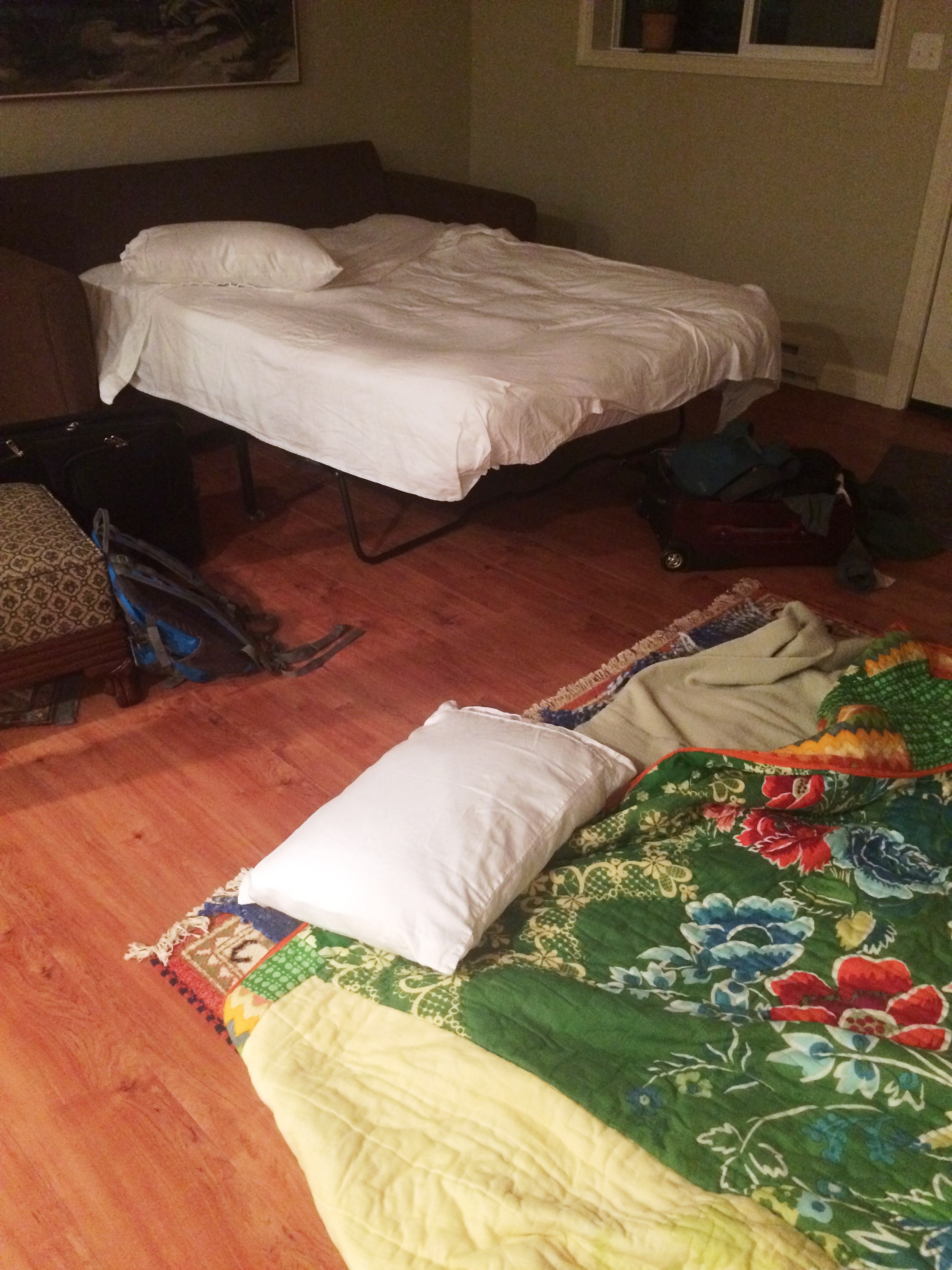
My story is a classic case of do as I say, not as I do. I transitioned, in one night, from a dense, squishy, memory-foam type mattress to two stacked blankets folded lengthwise on top of a hardwood floor with no pillow. The first 5 nights I experienced distressing this-is-why-i-haven’t-camped-in-10-years aches and discomforts. I moved around a lot to get comfortable and I was awakened every time I shifted in my sleep and reminded of how hard the floor felt. I suspected maybe I was making a big mistake – until I got up that first morning. Even though I had felt uncomfortable while I was on the floor, when I got up, there was NO stiffness to be found. I popped right out of “bed” and was completely mobile, buoyant, and fully alert. So I kept at it another five nights and noticed that I was beginning to feel more comfortable – less intentional position changing, less awakening when I shifted in my sleep, less sensitivity to the hardness. At about two weeks, I returned to the bed one night to see how that would feel. Immediately, what I call my “restless shoulder syndrome” returned. All night long, I was back to moving my arms over my head and back to my sides again and again to find comfort, but never finding it. Sleeping on my sides, I experienced that familiar ache in my shoulder joints. When I slept on my back, I discovered the mattress rounded my shoulders forward into an unnatural internal rotation, causing tingling and an unbearable urge to change position. When I became too uncomfortable, I would flop over onto my belly, but then my neck joined the chorus of discontent. Finally, in the early hours of dawn, I crawled back onto the floor and unbelievable relief and knew, immediately, viscerally, that I would never sleep on a mattress again. Over the next three months, there were occasional nights where my bony pelvis and tailbone would dig into the floor. At one point, I was beginning to experience a pressure sore on my tailbone. So that night, I reached for the faux sheep’s skin pad that used to extend my floor bed for Jolie the dog, when she wanted to co-sleep with me. Even though I had clearly experienced a decline in status from my partner and our other two dogs, who continued to sleep on the bed, Jolie is loyal and likes to snuggle, so I had placed that pad next to my floor bed for her. Anyway, on that night, while she was up with the higher-ranking members of our pack, I slid her pad under my hips and immediately transformed my bed. This addition of ¼ inch padding when squished, was enough to eliminate any further bony discomfort.  While I am perfectly delighted with the quality and comfort of my floor bed, I would prefer to sleep with my partner, thus I am making a more permanent floor bed for us out of stacked wool blankets that will be tufted together into a 2 inch thick sleeping pad, with inspiration from Pinterest and the DIY Internet people. I’ll post images when it is complete.

Here is a picture of where I currently sleep. It is comprised of a pendleton-like wool blanket and a standard comforter, both folded length-wise, and topped with Jolie the dog’s faux sheep skin pad.

My Floor Bed

My Floor Bed

And this is what happens when you invite us to sleep over at your house.

Kim's Dad's house

Kim’s Dad’s house

I’ve done some cursory searches of the scientific research literature – enough to tell you that there are few studies on sleep surfaces and almost nothing on ground/floor sleeping in the  anthropological, biomechanical, or medical literature. However, what I have read is interesting and I will share in a follow-up to this post.

Namaste, Michele

To all the shoes I’ve loved before

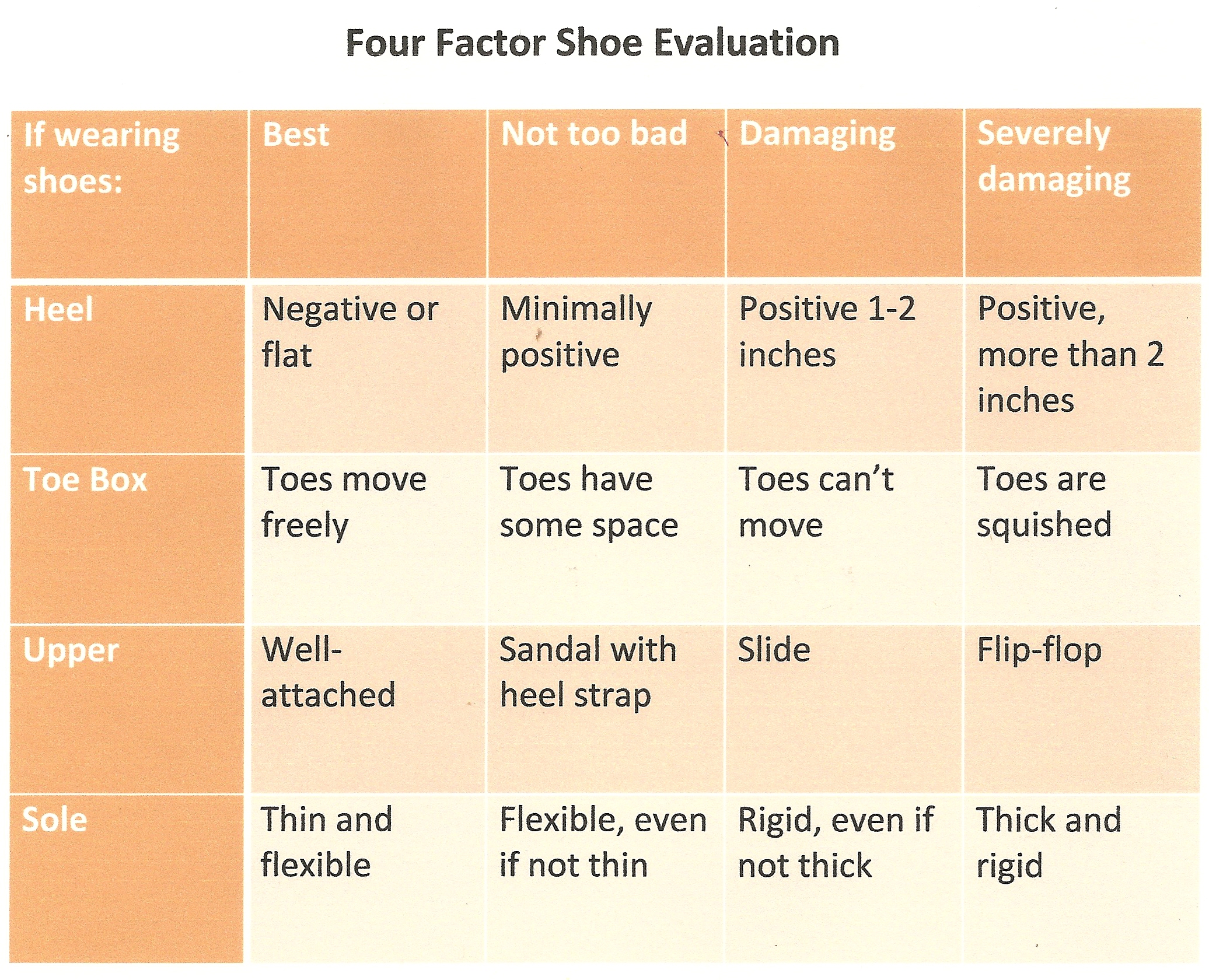
It’s time. It’s past time. We are moving to a smaller house in an act of intentional minimalist rebellion. I’ve been adding minimalist shoes to my closet over the last year, but have not reduced the total number of shoes residing there. To ease the ache of knowing that most of my pre-FootLove Yoga shoes will have to go, I revisit Katy Bowman’s Four Factor Shoe Evaluation (see chart below) to remind me why I make these tough decisions. When evaluating shoes, consider the four main features of a shoe and how and why they can be severely damaging. A feature that I did not systematically evaluate, but is present on over half of my shoes, is toe spring, that perky little incline at the toe end of a shoe. A toe spring bends the toes upward and over time deforms the foot, leading to foot problems, gait abnormalities, and musculoskeletal compensations.

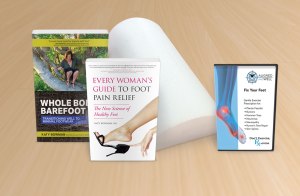
If you decide to transition to more minimal shoes, a must read is Whole Body Barefoot by renowned biomechanist Katy Bowman. You can find it in Katy’s Healthy Foot Kit.


Healthy_Foot_Kit-1

Heel – A positive heel is any degree of elevation above the height of the toe box. A traditional high heel is just one style of positive heel. I can’t say it any better than Katy when she describes positive heels as “bone density decreasing, nerve damaging, and arthritis causing” at any height. Not only do they cause whole-body deformation as they force you to change the geometry of all your joints to keep you balanced and upright, but they also increase the load on the front of your foot, exacerbating foot maladies like bunions, plantar fasciitis, and metatarsalgia, among others. At my last Foot Love workshop, I held up two shoes – a sparkly, silver stiletto and an athletic shoe. I asked which one is worse. All but one person said the stiletto. One gal said the running shoe. Everyone was right. The stiletto, being 4 inches high, would cause considerably more damage when worn, but chances are it is only being worn on special occasions for short periods of time. The athletic shoe, however, is probably being worn all day, every day. It’s a case of acute damage vs. chronic.

Toe Box – Chronic toe squeezing weakens the muscles of the toes and loads the bones while they are positioned incorrectly, increasing the occurrence of joint stress, bone stress, and other soft tissue deformation. What is utterly baffling  is that shoe creators continue to design shoes that taper at the toe, when in fact, the ends of the toes are the widest part of the foot and therefore requires that area to be the widest part of the shoe! Dr. Ray McClanahan details this phenomenon in the context of bunions and the brannock device, that foot measuring tool that shoe fitters use to measure your foot. A whole industry uses this device to measure your foot at the ball rather than at the weight-bearing, toes-spreading, widest area of your foot.

Brannock device

Brannock device

Upper – Flip flops and slides require a gripping action from the toes. This gripping motion is the same muscle pattern that deforms toe joints. As the upper gets smaller, your foot has to constantly grip to keep the shoe on. Its Hammertime Hammertoes!

Soles – The thicker and stiffer the sole, the less the intrinsic foot musculature is able to do, the less communication happens between the brain & feet, the less circulation (nutrition & waste removal) and the more compensatory movement at the ankle and other joints. I elaborate on the importance of intrinsic foot musculature in an earlier post.

fourfactorshoe0001

So, here are all the shoes I’ve loved before…at least all that are still in my closet or sitting in Salvation Army (since yesterday.) I’ve devised a rating system. The lower the number, the better the shoe. The rating system goes from 4 – 16. A shoe with a rating of four has all boxes checked in the Best column – one point per feature. A shoe with a 16 has all four boxes checked in the Severely Damaging column – four points per feature. If a shoe gets over 6 pts, its got to go. Got it?

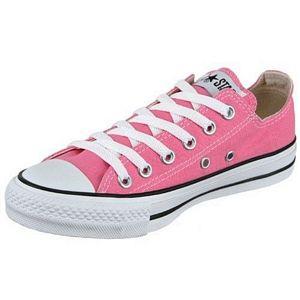
Shimmery pink converse

Shimmery pink converse

This is not the actual image of my shoe, because the real pair sadly lives at the Salvation Army.

  • heel – 1 pt
  • toe box – 3 pt
  • Upper – 1 pt
  • Sole – 4 pt
  • Total – 9 pt; status – donated
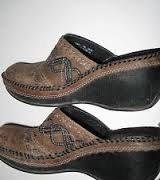
Clarks clog

Clarks clog

Another stand in; not the same model I had, but close.

  • heel – 4 pt
  • toe box – 3 pt
  • upper – 3 pt
  • sole – 4 pt
  • Total – 14 pt; status – donated
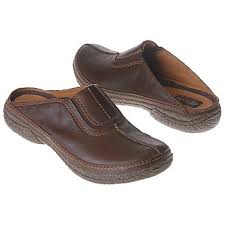
Clarks mule

Clarks mule

Another stand in.

  • heel – 3 pt
  • toe box – 2 pt
  • upper – 3 pt
  • sole – 4 pt
  • Total – 12 pt; status – donated
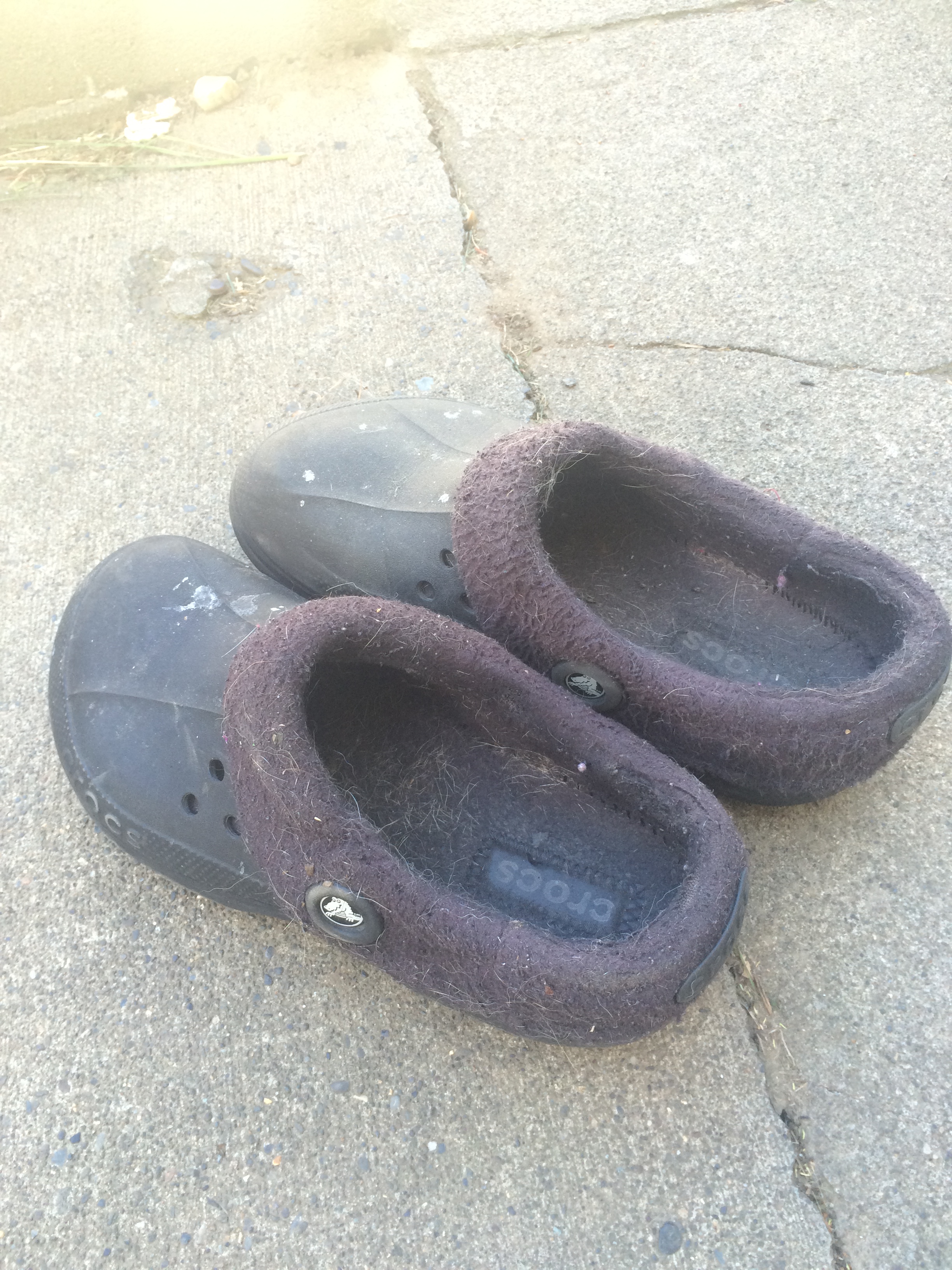
Crocs slippers

Crocs slippers

  • heel – 2.5 pt
  • toe box – 1 pt
  • upper –  1 pt
  • sole – 2 pt
  • total – 6.5 pt; status – retired for several months as I am now barefoot full-time in the house
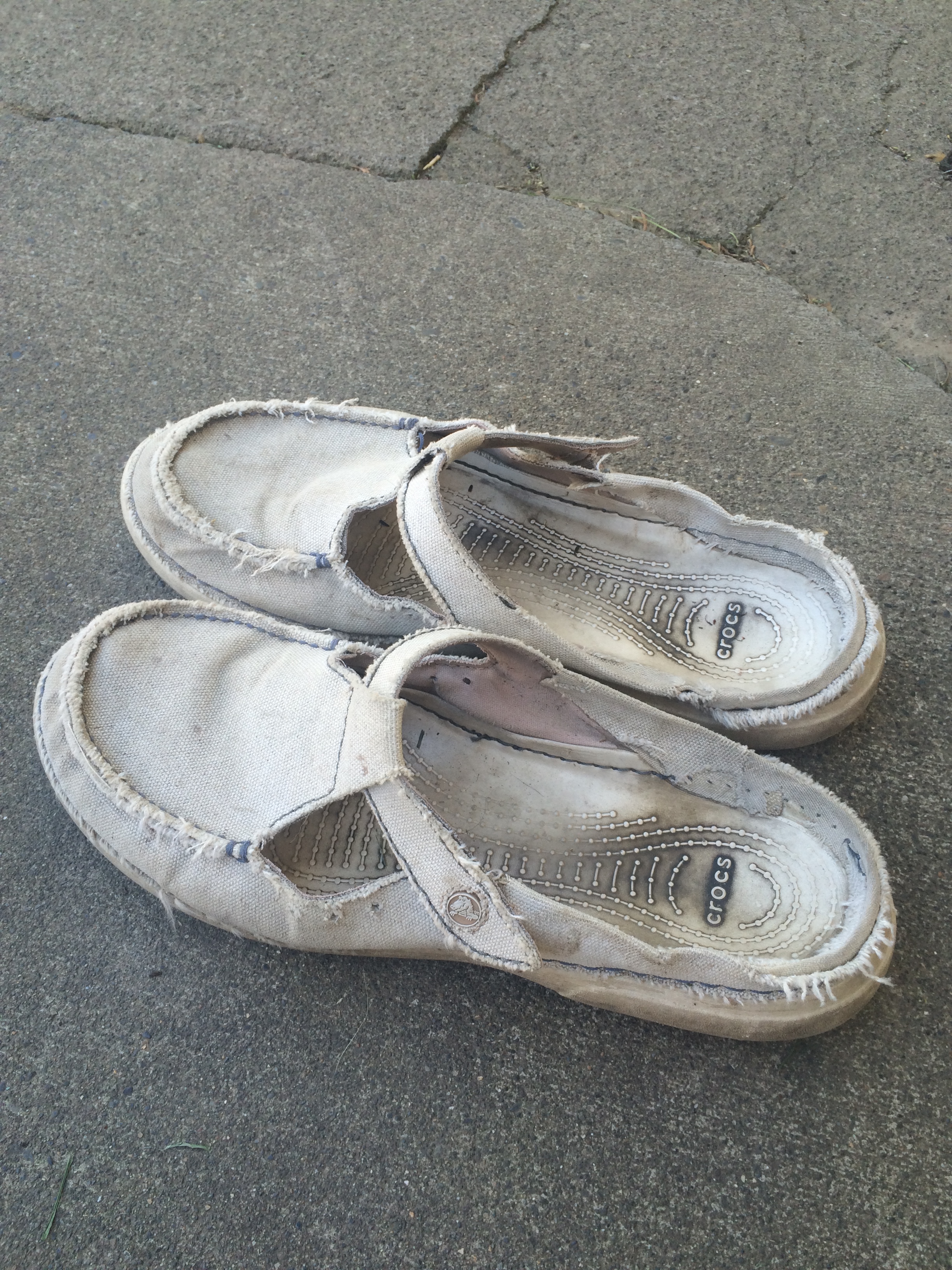
Crocs mules

Crocs mules

  • heel – 2 pt
  • toe box – 2 pt
  • upper – 1 pt
  • sole – 1 pt
  • Total – 6 pt; Status – keep – these are my garden/dog poop detail shoes
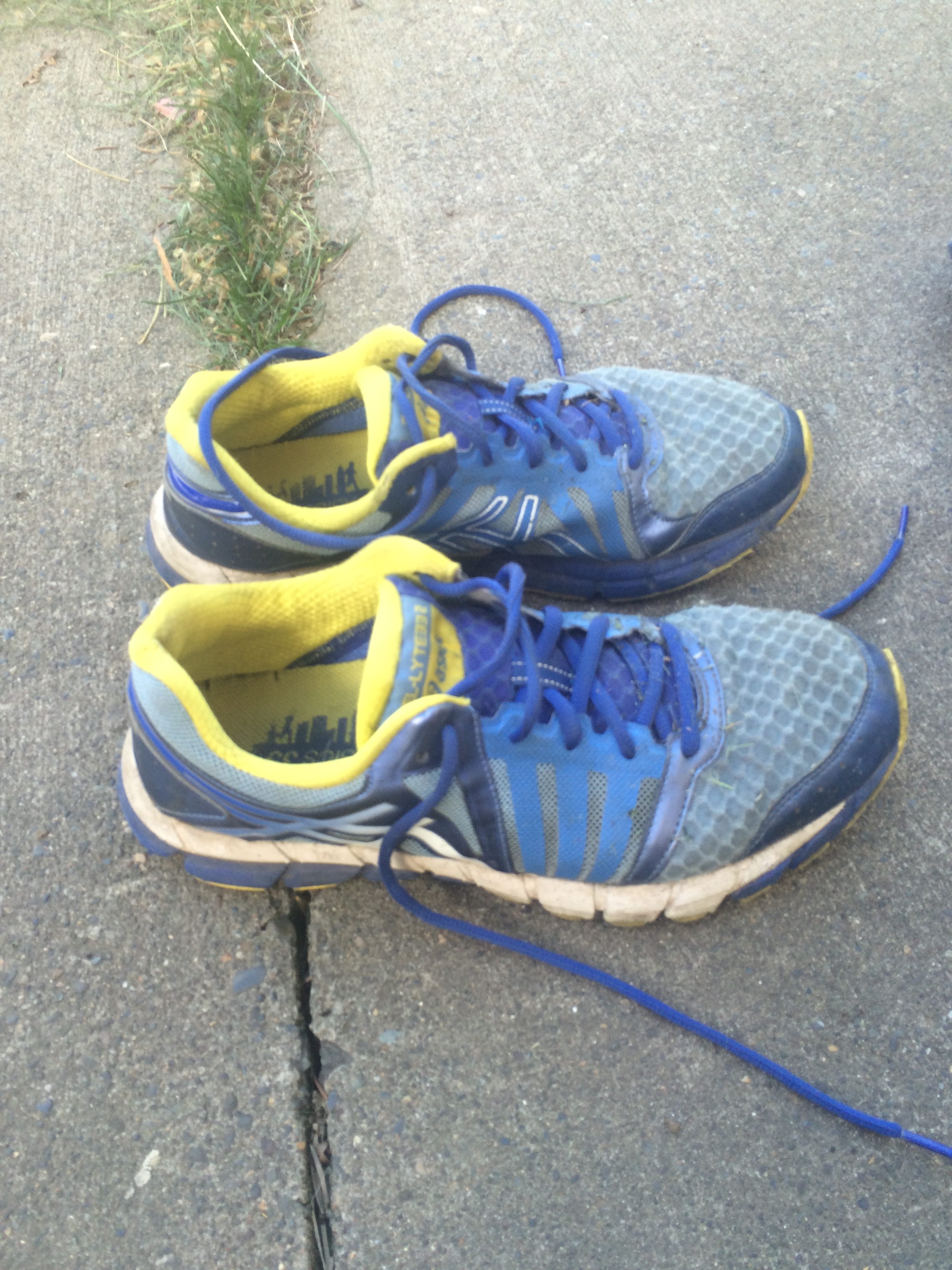
ASICS athletic shoes

ASICS athletic shoes

  • heel – 3
  • toe box – 3
  • upper – 1
  • sole – 1.5
  • Total – 8.5 pts; Status – retired to heavier garden duty like digging/mowing
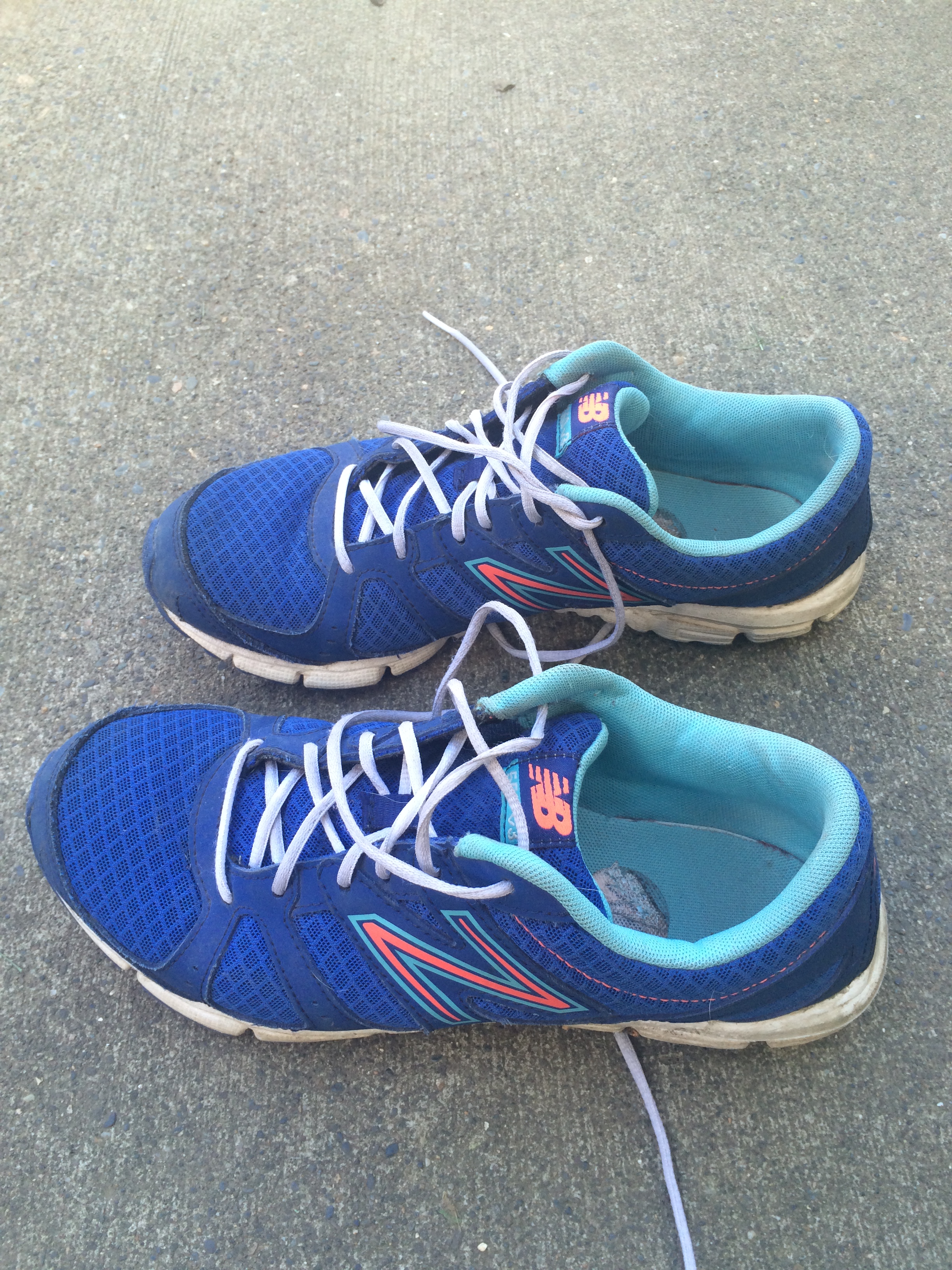
New Balance athletic shoes

New Balance athletic shoes

  • heel – 2.5
  • toe box – 3
  • upper – 1
  • sole 1.5
  • Total – 8 pts; status – keep for now but wear only when walking primarily on asphalt; replace with minimal shoes that can be safely worn on asphalt
Naturalizer

Naturalizer

  • heel – 2
  • toe box – 3
  • upper – 1
  • sole – 2
  • Total – 8 pts; status – keep and wear only on rare, special occasions
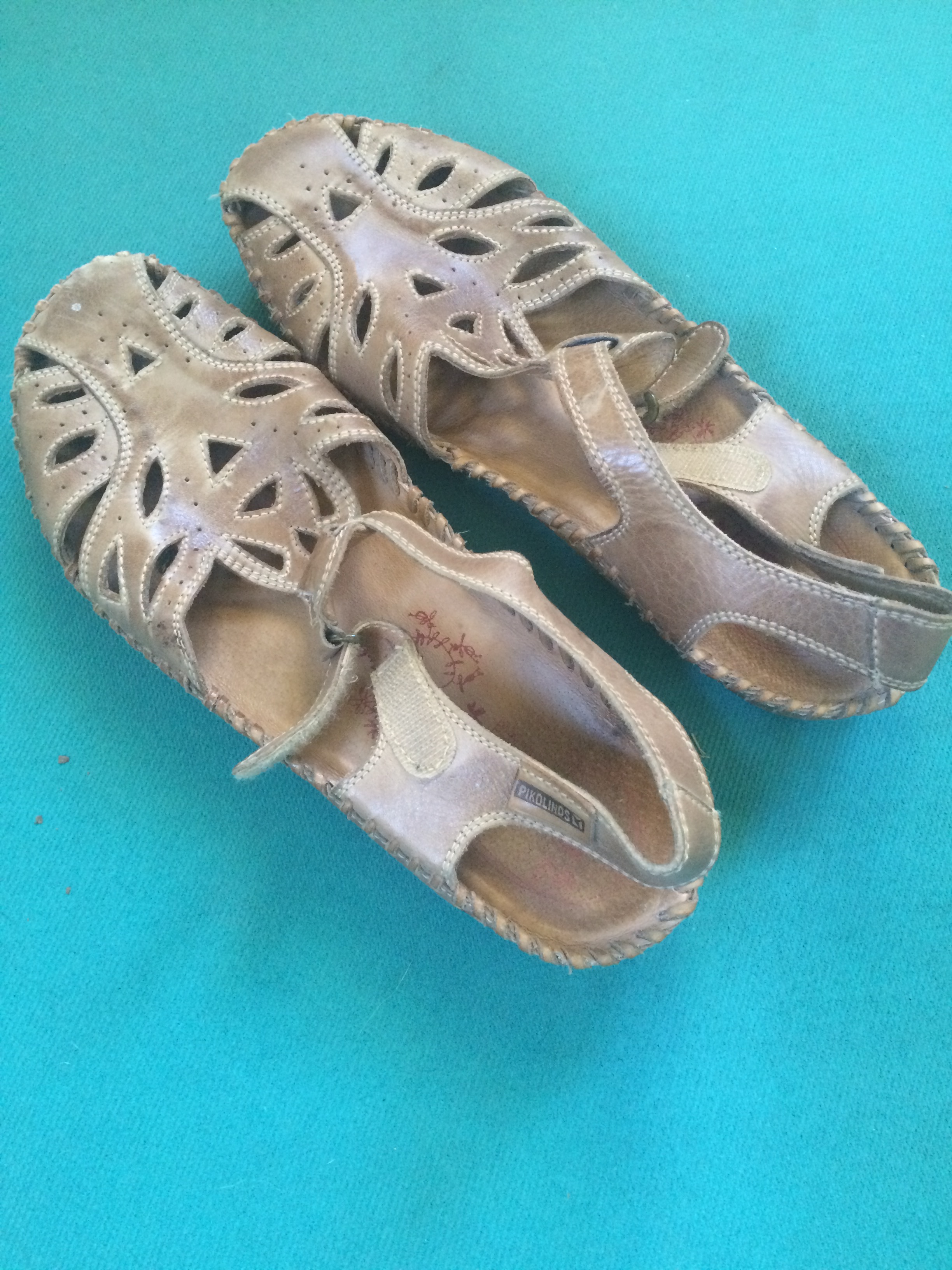
Pikolinos sandle

Pikolinos sandal

  • heel – 2.5
  • toe box – 2
  • upper – 2
  • sole – 3
  • Total – 9.5 pts; status – keep, wearing only on rare, special occasions
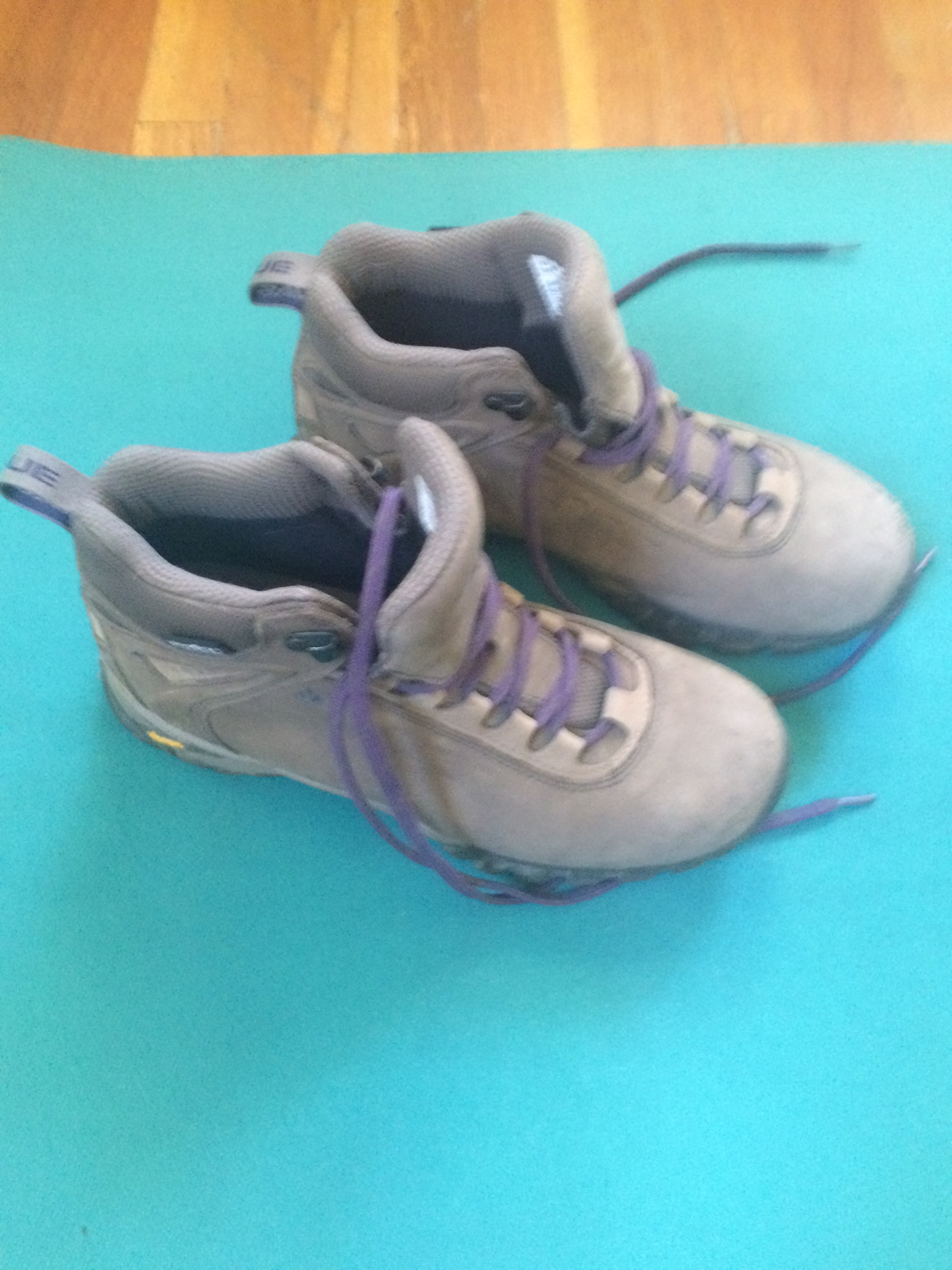
Vasque hiking boots

Vasque hiking boots

  • heel – 3
  • toe box – 3
  • upper – 1
  • sole – 4
  • Total – 12 pts; status – cry. actively seek minimalist hiking boots. cry some more
004

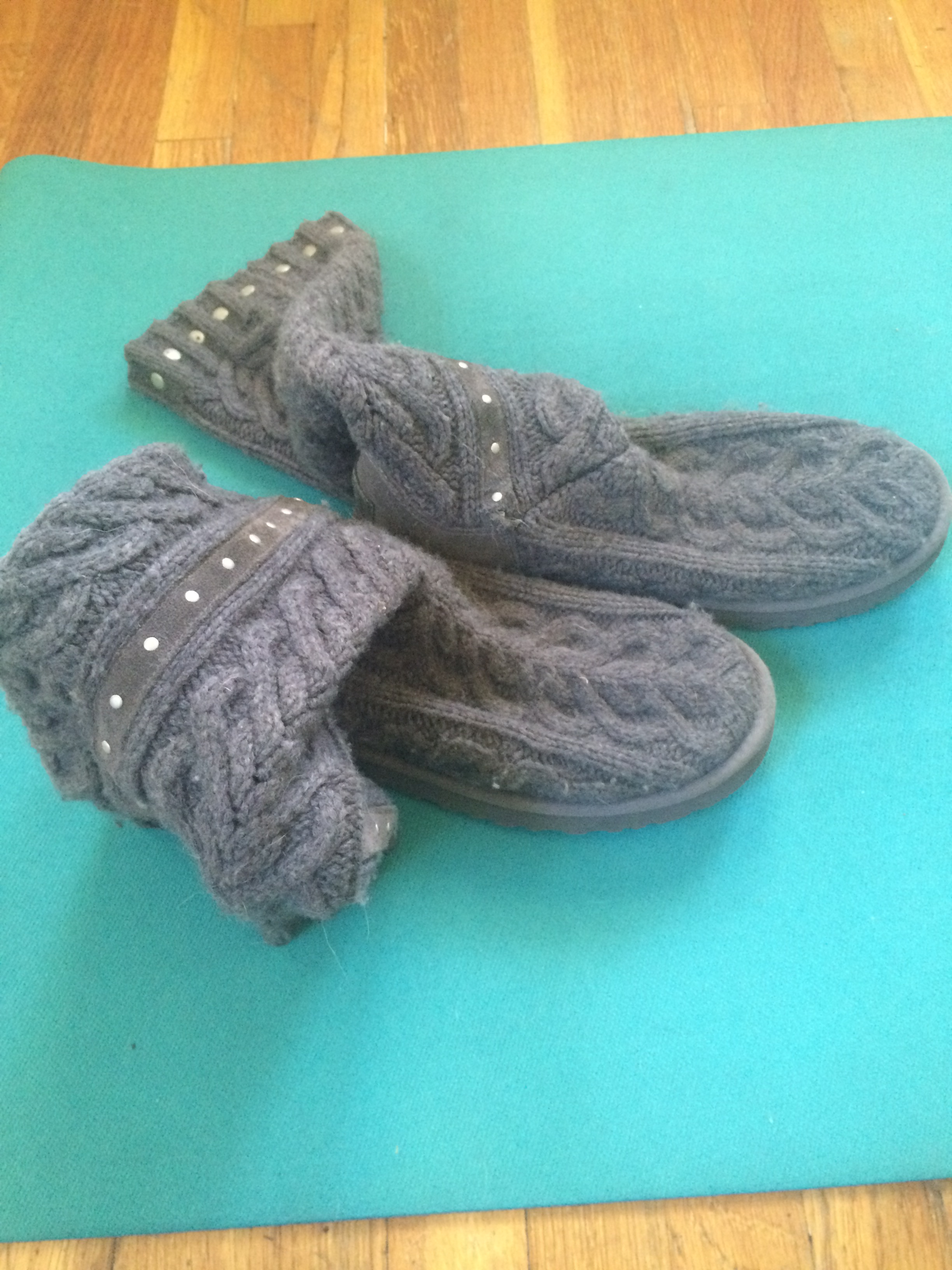
UGG boots

  • heel – 2
  • toe box – 1
  • upper – 1
  • sole – 4
  • Total – 8 pts; status – keep and wear whenever I damn well please; these are my one pair of fashion over foot-health shoes
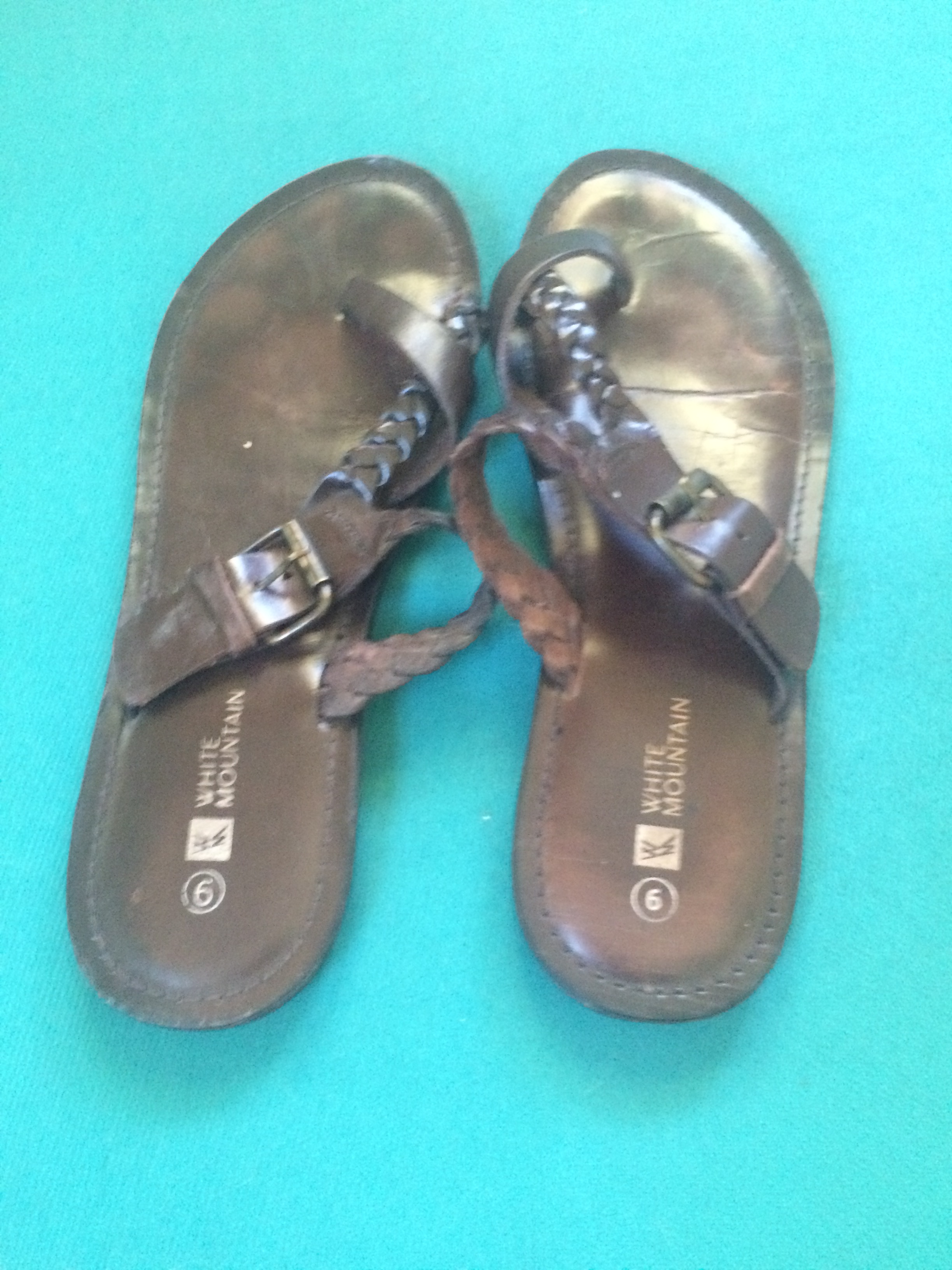
White Mountain sandals

White Mountain sandals

  • heel – 1.5
  • toe box – 1
  • upper – 4
  • sole – 1.5
  • Total – 8 pts; status – donate
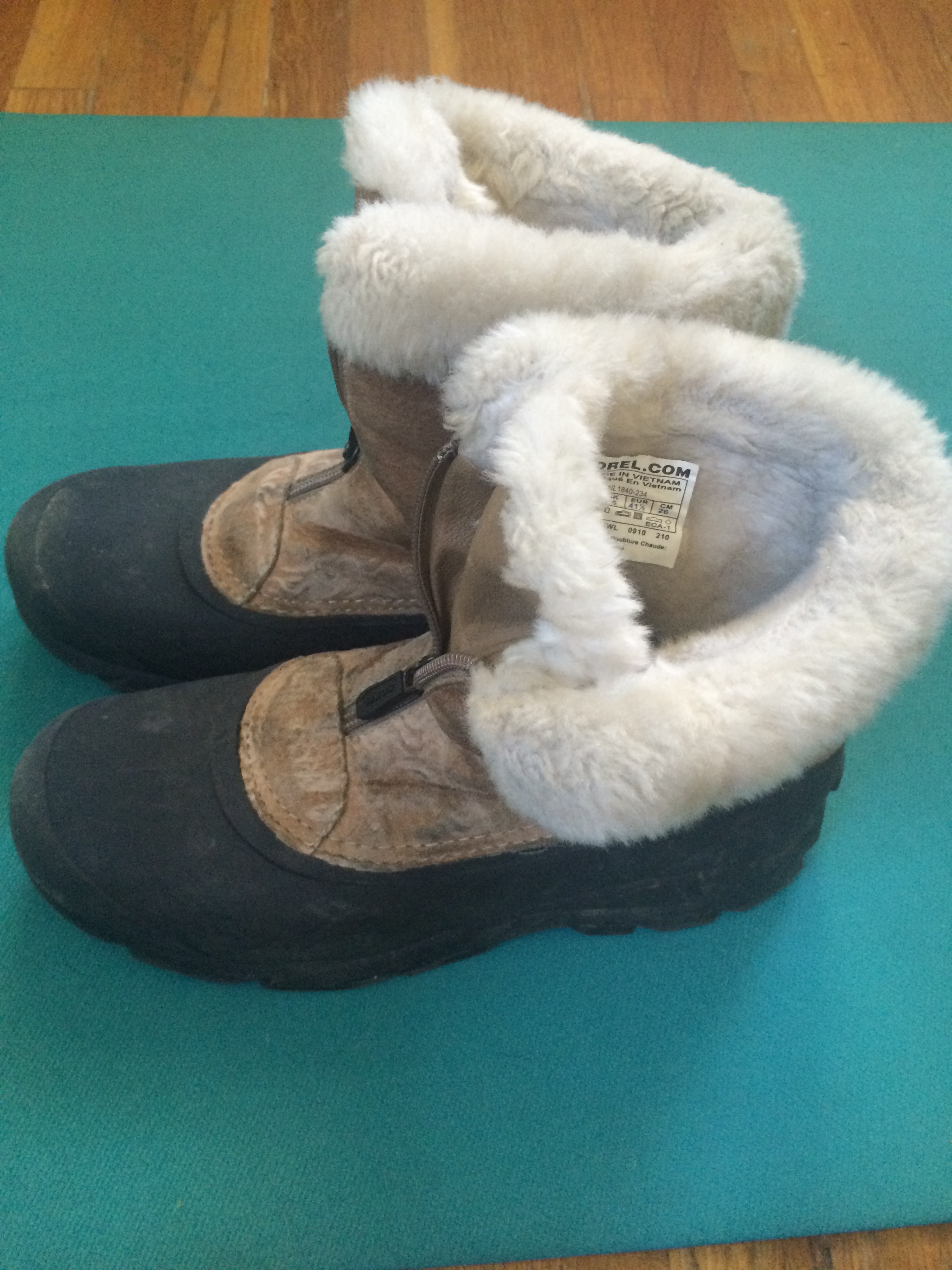
Sorel snow boots

Sorel snow boots

  • heel – 3
  • toe box – 3
  • upper – 1
  • sole – 4
  • Total – 11 pts; status – uh, it didn’t snow this year…actively seek a minimal pair of snow boots in case it snows next year
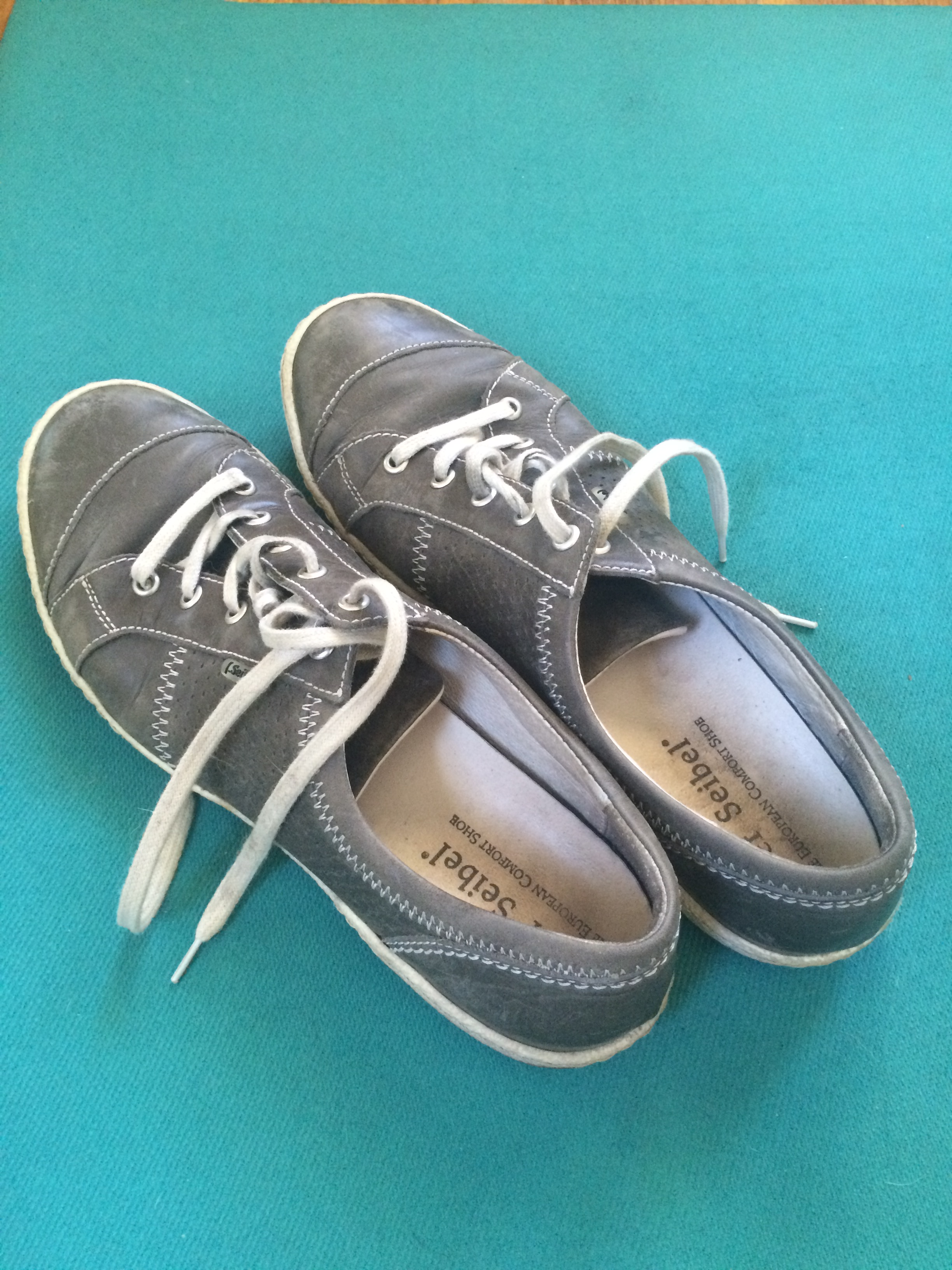
Joesef Seibel metrosexuals

Joesef Seibel metrosexuals

  • heel – 1
  • toe box – 3
  • upper – 1
  • sole – 1
  • Total – 5 pts; status – keep and wear occasionally
Crocs sandals

Crocs sandals

  • heel – 2
  • toe box – 3
  • upper – 3
  • sole – 2
  • Total – 10 pts; status – donate

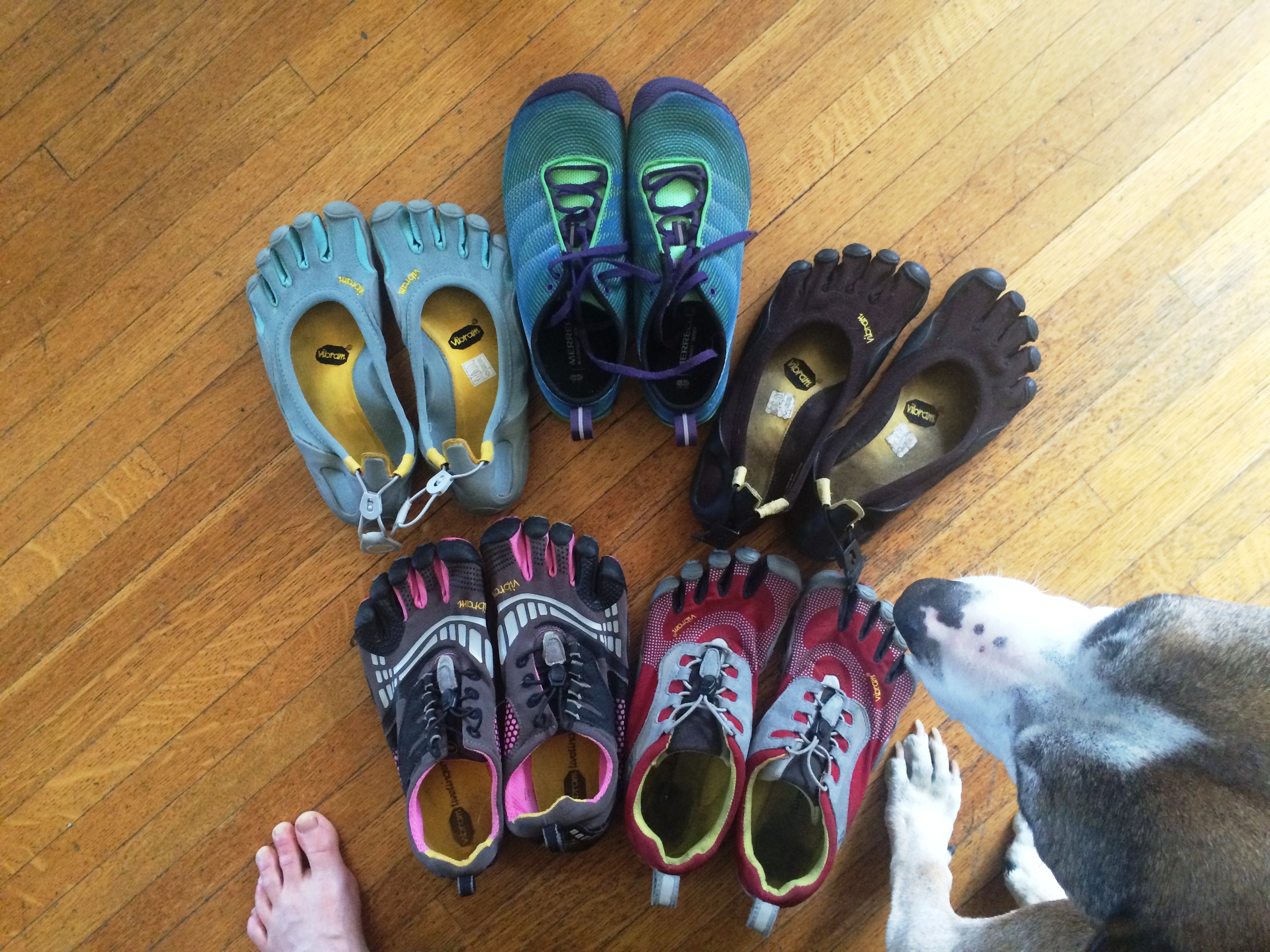
And the winners, coming in at a mere four points each, are:

Vibram Five Finger and Merrel Vapor Glove

Vibram Five Finger and Merrell Vapor Glove and Jolie.

How does your closet add up?

Namaste, Michele

How to Build a Bunion – Part 1

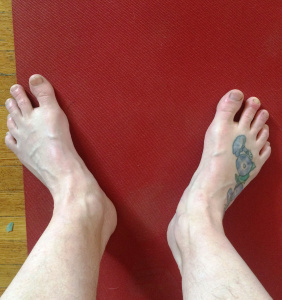
For those who participated in the PNWU Run For Your Life 5K Run Health Fair, you may want to consider your foot alignment and how a foot turnout while running can contribute to the painful condition of a bunion.

Michele McGinnis's avatarMichele McGinnis

A bunion, aka Hallux Valgus, is the most common foot deformity in adults. It presents as a lateral protrusion of the big toe joint. Inflammation with reddening and swelling, pain, and numbness are often present. In more severe cases, the toe deviates medially toward the other toes, sometimes going completely sideways and moving under them. Bunions impair weight bearing and balance, increase the risk of falling, and worsen physical performance and quality of daily life.

If you are sitting, stand up, walk across the room, come back and remain standing. Really, do this before you read further or you might influence the results.

Now, look at your feet. Do they look like this?

Feet definitely not pointing straight ahead. Feet definitely not pointing straight ahead.

Most do. So what, you might ask? Why does it matter? I counter with a question. Would you want these wheels on your car? I didn’t think so. Our feet, like…

View original post 380 more words

Barbie Foot – January 6, 2005

For those who participated in the PNWU Run For Your Life 5K Run Health Fair, you may want to consider this exercise as a way to care for your feet after this and any run.

Michele McGinnis's avatarMichele McGinnis

Remember the bit about our feet having 33 joints each? And the other bit about how we rarely use all those joints because our feet are often casted in shoes, walking on flat uninteresting surfaces, or not moving at all? This exercise, Barbie Foot, is great for mobilizing your foot joints, improving blood flow (aka tissue food) and cellular waste removal, maybe even lowering your blood pressure!

A video of Barbie Foot is available on my Facebook page.

Sit on the floor with your legs extended out in front of you – in Dandasana for the yogis/yoginis out there. If you are not used to sitting on the floor, it may become fatiguing or otherwise uncomfortable, so try sitting with your back against a wall or on a bolster or stack of folded blankets. Place your hands on the floor alongside your hips for additional support, or, if you are…

View original post 379 more words

Prop Review – Alignment aka Toe (Spreading) Socks

For those who participated in the PNWU Run For Your Life 5K Run Health Fair, you may want to consider these socks as a way to care for your feet after this and any run.

Michele McGinnis's avatarMichele McGinnis

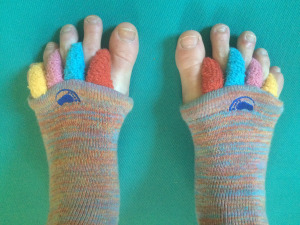
If you’ve been to my Facebook page, you’ll have seen toe socks on my cover photo. I’m not referring to socks with little glove fingers in them, but socks like this:

029

Alignment socks are a great way to passively stretch your toes after they’ve been casted in shoes all day, particularly shoes with tight toe boxes that don’t allow your toes much mobility. Tight toe boxes don’t have to feel tight. Remember the tracing I made of my foot from matting paper earlier this week? I was unable to slide it into one of my favorite shoes because the stiff card stock would not yield or deform the way my foot does when I slide it into my shoe. This tells me that my toe box, even though it feels comfortable, does not have enough room to house my foot in a healthy manner. Toe boxes that don’t allow…

View original post 144 more words

Dear Friend, you are ruining your feet, and your health, to be fit – an open letter

I have a friend who is having foot pain. Serious foot pain. It has kept him from doing “any vigorous exercise in a full 7 days,” leaving him “pissed off all day and scowling.” This could be the best thing that ever happened to him. He thinks that his pain may have been brought on by “lots of running and time spent in tight climbing shoes.” I think he’s right. I’ve been there brother.

Dear Friend,

We run and engage in other strenuous endurance activities because we think we are doing something good for our cardiovascular health, but we aren’t. Running over a certain point of intensity/endurance is the stress equivalent of being chased by a bear. You may improve your “fitness” aka athletic performance by running strenuously, but you do it to the detriment of your heart and blood vessels. Strenuous endurance activities cause your heart to pump really hard for a long time and may induce pathological structural remodeling of your heart – scar tissue, fibrosis, stiffening of the heart muscle, and premature aging.  Running causes blood to flow turbulently through your arteries resulting in vessel injuries that becomes plaque (yes, that plaque), which is essentially your arteries’ version of scabbing. You’ve only ever heard that you need to get your heart rate up for cardiovascular health. But, keeping your heart rate up over a certain intensity/time overworks your heart and causes a major stress reaction to the rest of your body.

The part of cardiovascular health that you probably haven’t heard is that your muscles, all 600 of them, need to be moving as much as they can, all day long. It’s this skeletal muscle pump that actually pushes blood into your capillaries and on into your cells, feeding them, creating a healthy environment for your nerves, and removing cellular waste via the corresponding lymph system. As I wrote in my post on boobs, its natural movement – lots of walking, squatting, climbing, etc. that is required by our biology. If you are moving throughout your day, your heart can work less because you are instead relying on the skeletal muscle pump to get oxygenated blood to your cells.

If you think running more and faster makes you live longer, the research doesn’t support it. A 2015 study published in the Journal of the American College of Cardiology found that running over 2.5 hours per week or at higher frequencies – more than 3 times per week – and at faster paces (7 miles per hour or an 8 minute mile) is NOT associated with better survival compared with sedentary non-runners. In fact, strenuous runners were as likely to die, during the 35 years of the study, as sedentary non-runners. Light and moderate joggers fared better, in that order. These joggers ran anywhere from 1 – 2.5 hours per week, 3 or fewer times per week, and at a much slower pace – as low as 5 miles per hour or a 12 minute mile. This study comes on the heels of several studies that show running more and harder is not a healthful activity. High intensity fitness activities, including serious running, are performance based, not health based and do not hold up the gold standards of health – longevity, bone density, joint health, and pelvic floor function. On the contrary, high intensity fitness activities  often break down these standards.

So, I could tell you, my friend with disabling foot pain, to replace strenuous running with light to moderate jogging, but my concern is not for your heart. It is for your whole body health. You took a climbing fall 10 years ago, smashing your foot and ankle on a rock ledge. You wear 5-6 screws in there now.  As a result that foot turns inward when you run. That mal-alignment is obvious from a comparison of the tread wear on the soles of your running shoes. It’s that foot turn that worries me. What I know about foot and gait biomechanics is that if your foot is not aligned as it goes through heel strike, foot flat, heel lift, and toe push-off phases of gait, then your body’s major joints (ankles, knees, hips, spine, and shoulders) will compensate by moving out of their respective alignments. Mal-aligned joints become degenerating joints and chronic pain. It’s not a matter of if that mal-aligned, in-turning foot will wreak havoc; it’s when. It’s happening now to you, my friend, at the local level of the foot. It’s just a matter of time before your feel it other places.

Let’s say a 150lb man walks one mile. Impact forces to his bones and joints are about 110% or just a bit over his body weight, resulting in a mind-boggling force of 175 tons (!) to his feet. If this same man runs, those impact forces are 300-400% or three to four times his body weight, resulting in a staggering force to his feet in excess of 350 tons! With these forces on a hardware-compromised, mal-aligned, painful foot, would I recommend that you jog instead of run? No efff’ing way. My friend you must retire your running shoes (and gets some climbing shoes that fit for God’s sake) and walk instead. Running will not be worth it in the short or long run.

The health benefits of walking are outside the scope of this letter, but please understand that evolution adapted our bodies to walk. Early humans walked or trekked about 8 miles a day to hunt and gather, only running in short bursts by necessity while hunting or being hunted. Your body is adapted to walk. Your body requires lots of walking, every day. Your foot needs you to walk, not run. Unless you are being chased by a bear.

Please let me know if I can help you to move with better alignment. Be well my friend. Michele

My Top 25 Movements at My Standing Work Station

I spend several hours a day writing, studying, and managing the Yoga Collective of Yakima. Several months ago, I transitioned from sitting to standing at a DIY work station. Standing (in good aligment) has so many benefits over sitting. I’ll mention just a few:

  1. It makes the bones of your legs weight bearing, thus signaling them to build greater density. This is especially important for you hips
  2. It innervates the muscles of your posterior kinetic chain (back, butt and hamstrings), improving the flow of blood, electricity (nerve signals), and lymph (cellular waste removal)
  3. It strengthens your legs because they are having to work to hold you up. I’ve always had a shapely bottom, but spindly, flabby legs – think $10,000 hat on a 10 cent head. After standing for a few months, my legs, for the first time ever, are beginning to look toned and strong.
  4. I have been plagued with varicose veins for most of my adult life. Since standing to work, I still have them, but they are definitely improving.
  5. And my favorite benefit is that if affords me many, many opportunities for movement nutrition.

If you sit all day for work, you are putting your health in grave danger. Just google “sitting is the new smoking” or “dangers of sitting too much,” and you will get a gazillion hits, including sobering research on the subject. But if you decide to stand instead, it is critical that you not trade one form of sedentary (sitting) with another – standing still. Here is just a sampling of the ways that I move, when I am standing at my work station. I’ve included descriptions, links to tutorials, and/or images for many of them.

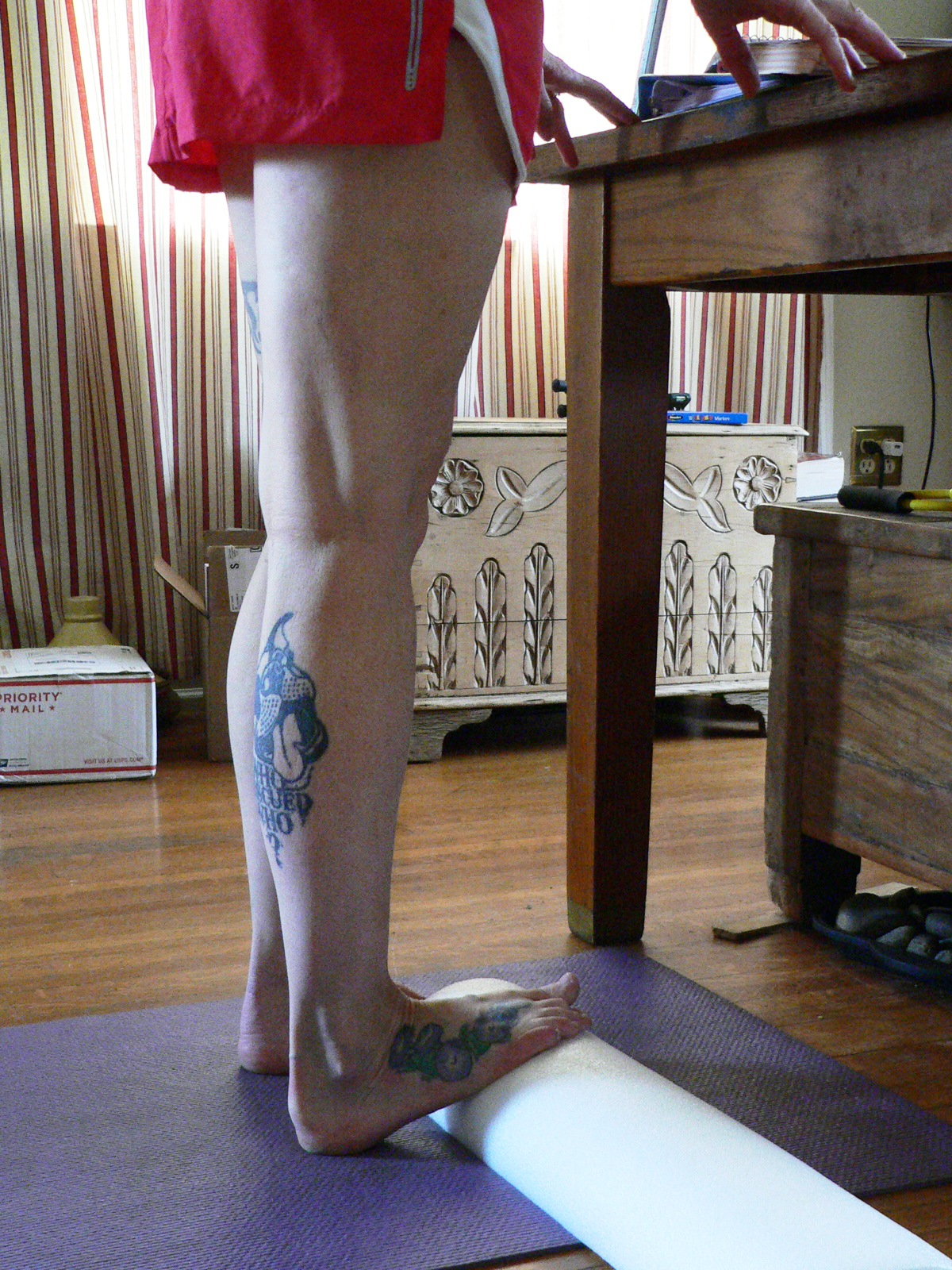
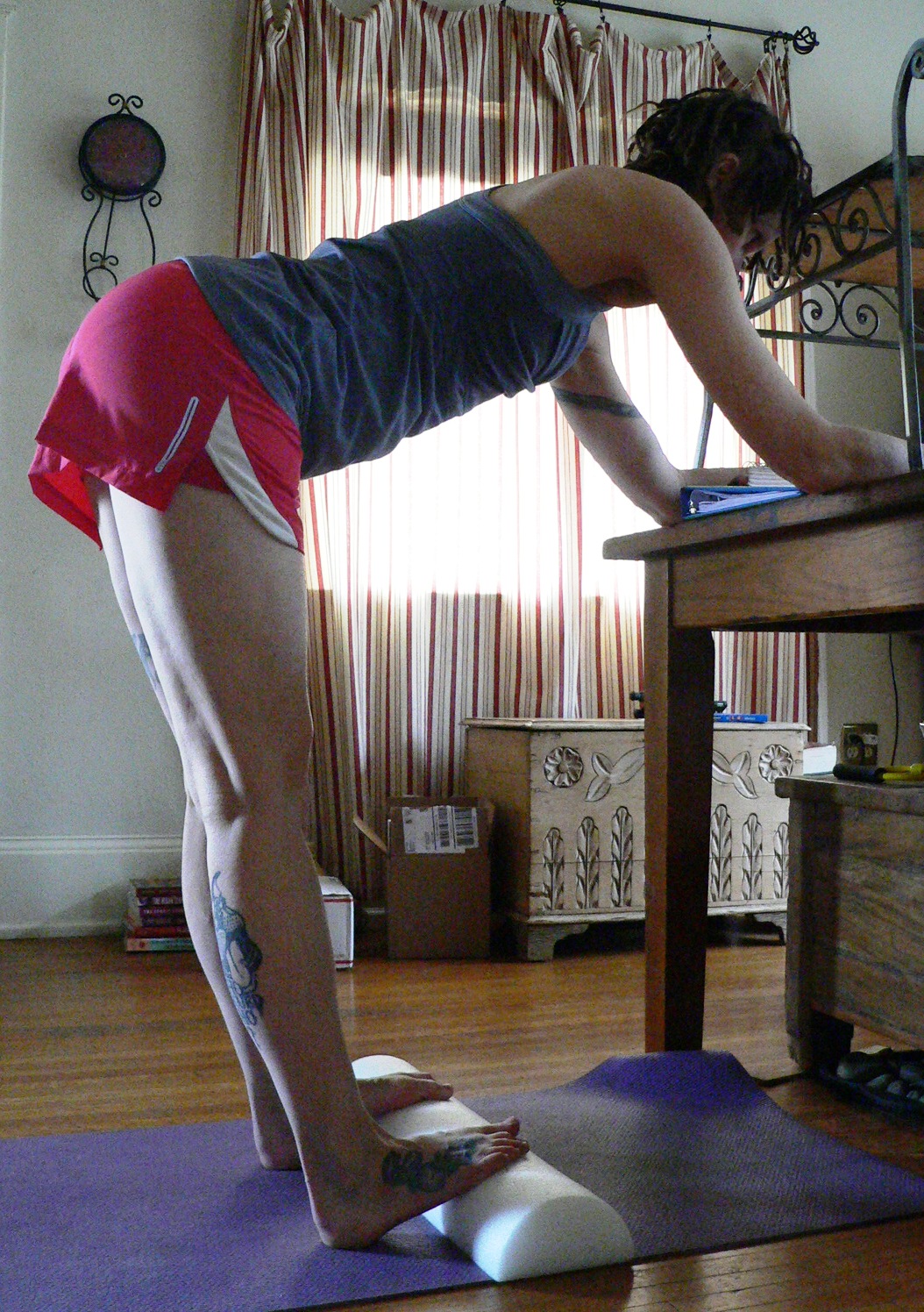
  • Calf stretch – you can buy SPRI Foam Roller Full Round – 36-Inch x 6-Inch Diameter Foam Roller from Amazon and cut it down to size. I cut mine into three 6″ pieces and one 18″ piece and use them in a variety of ways. For detailed alignment on the calf stretch, check out Petra Fisher at Movement Revolution. She’s super smart about alignment and standing work stations.
    Calf stretch
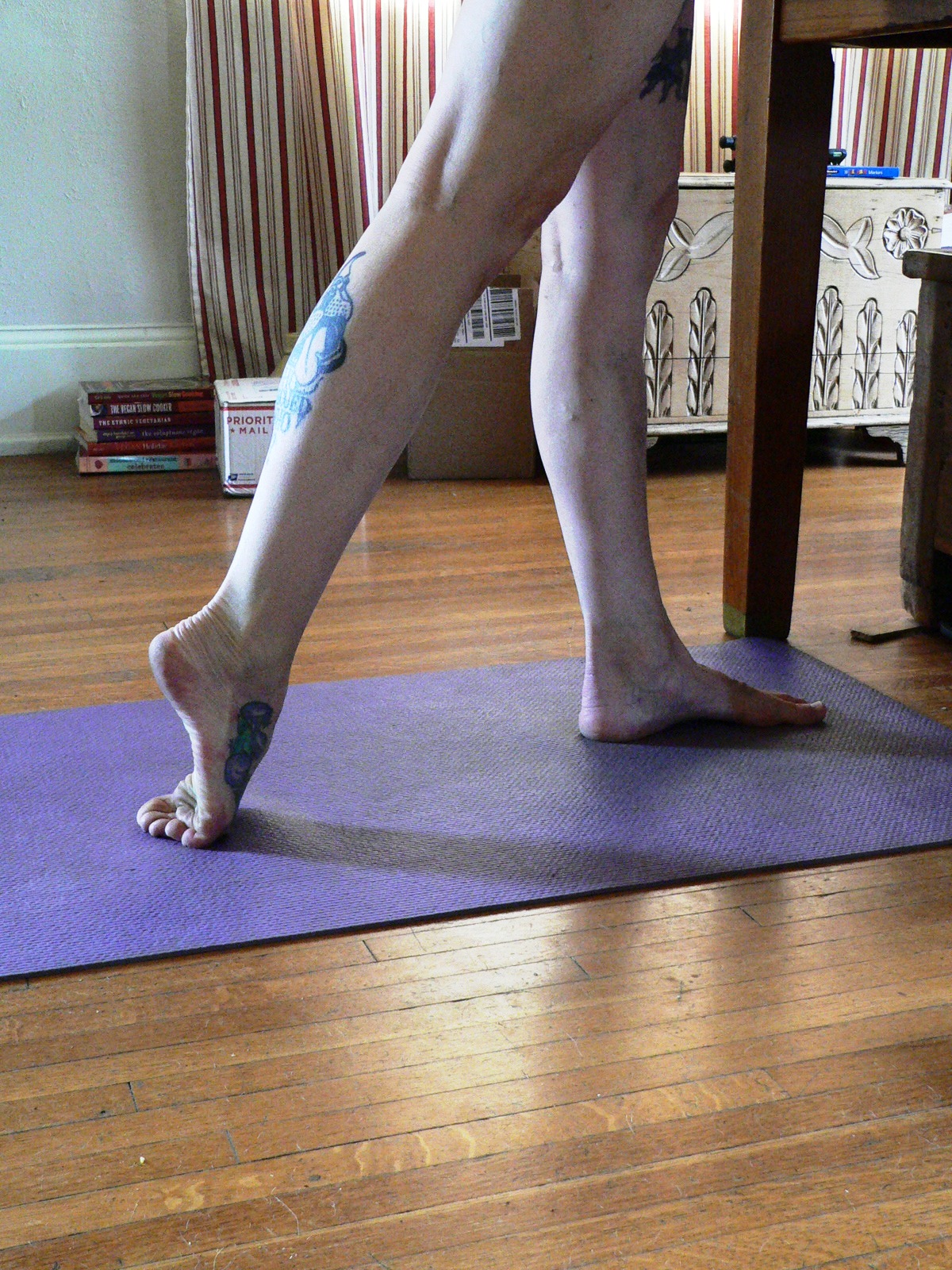
  • Top of foot stretch
  • Top of foot stretch
  • Ball rolling – See also a great article and video from Terry Littlefield at Yoga Tune Up
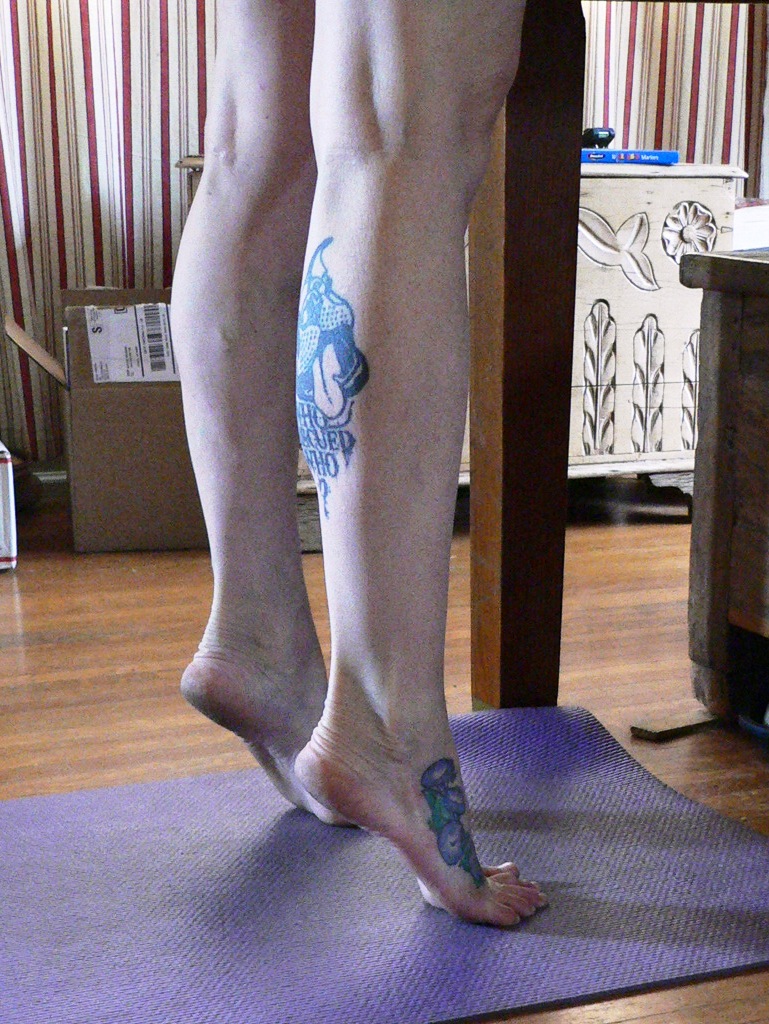
  • Calf elevators – you can lift and lower or work on holding in balance
  • Calf raises aka calf elevators

    Calf raises aka calf elevators

  • Toe lifts
  • Hamstring stretch
  • Hamstring stretch

    Hamstring stretch

  • Monster walk – an entertaining video from my teacher, biomechanist Katy Bowman, doing the monster walk. I go side to side in from of my desk when I am listening to lectures.
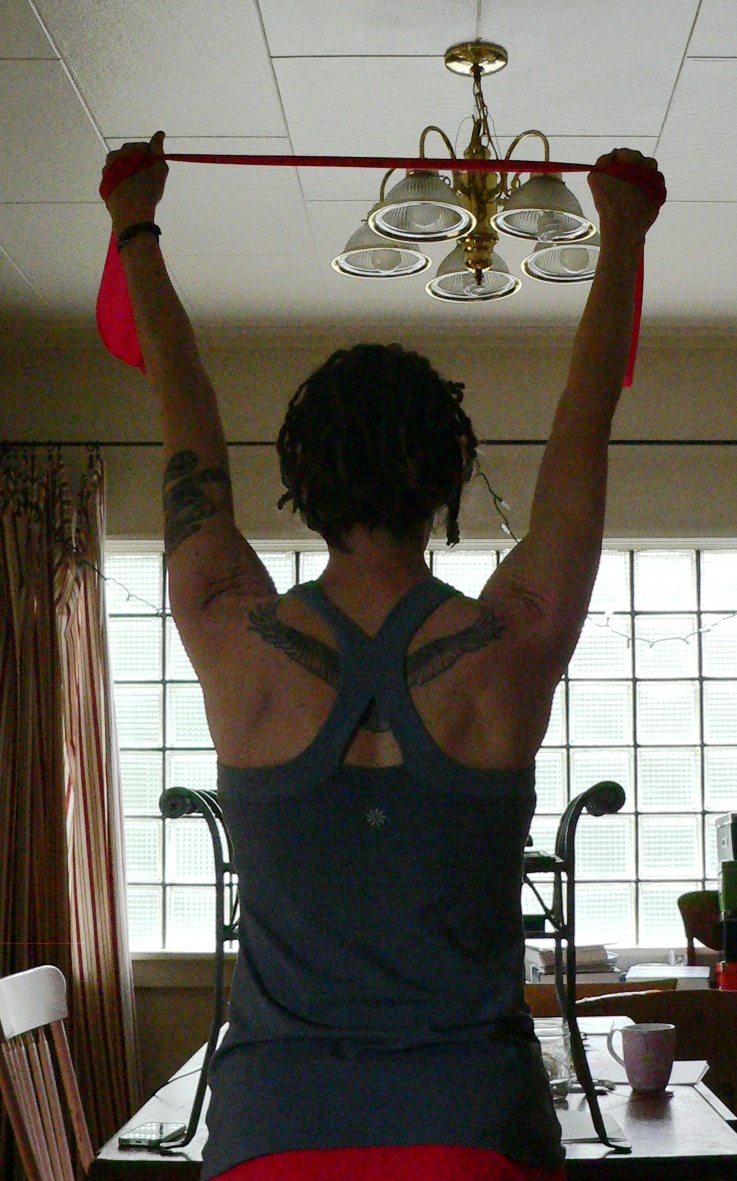
  • Shoulder strap – i explore many movements – shoulder flexion, shoulder extension, twists, lateral bends, varying the distance between my hands, etc.
  • Strap play

    Strap play

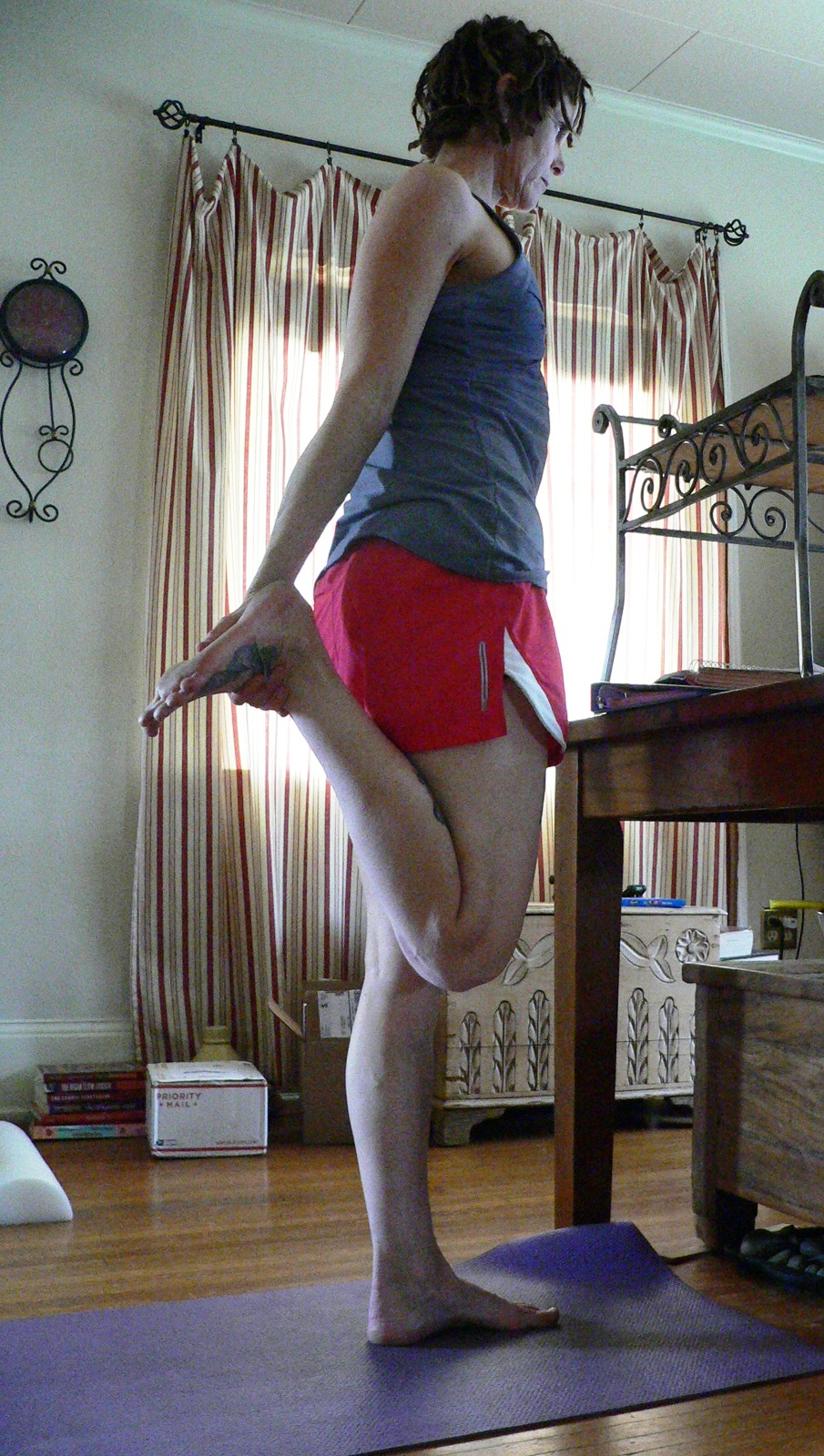
  • Quad stretch
  • Quad stretch

    Quad stretch

  • Hand stretches – there are so many variations, but basically, you are stretching your fingers in their natural ranges of motion
  • Finger extensions

    Finger extensions

  • Rock tray
  • Pelvic list – a little tamer video from Katy Bowman
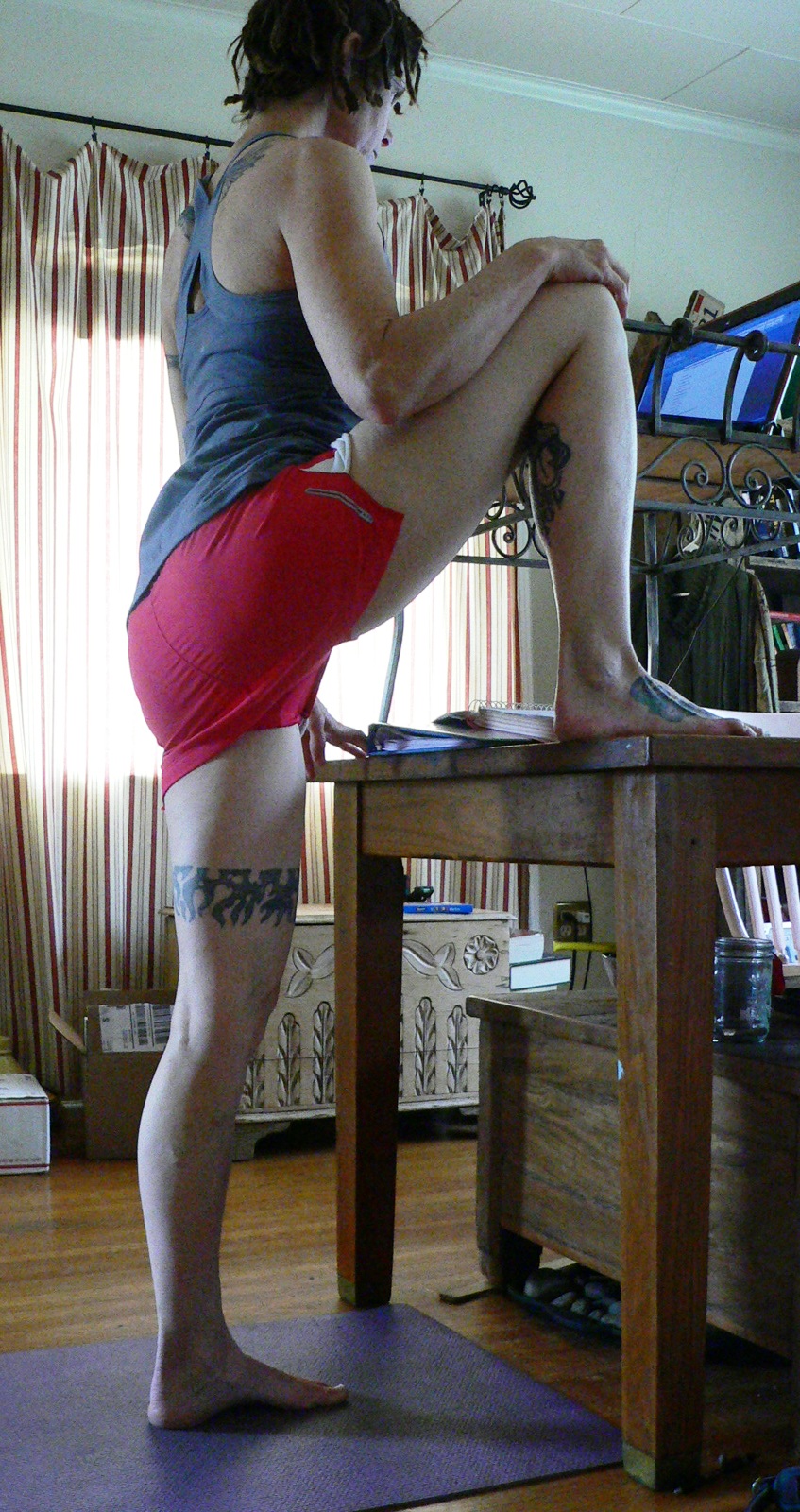
  • Giant step – this can be done on any height surface – stool, chair seat, counter, etc.
  • Giant step

    Giant step

  • Distance gazing (opposite of navel gazing) – Step away from your station, look out the window, and let your gaze soften and become hazily focused (not squinting) on something further off in the distance. Try to pick out architectural landmarks, differentiate between leaves and branches, follow birds in flight, anything to relax the muscles you use 99% of the time staring at screens, books, television, and anything within a few feet of your face.
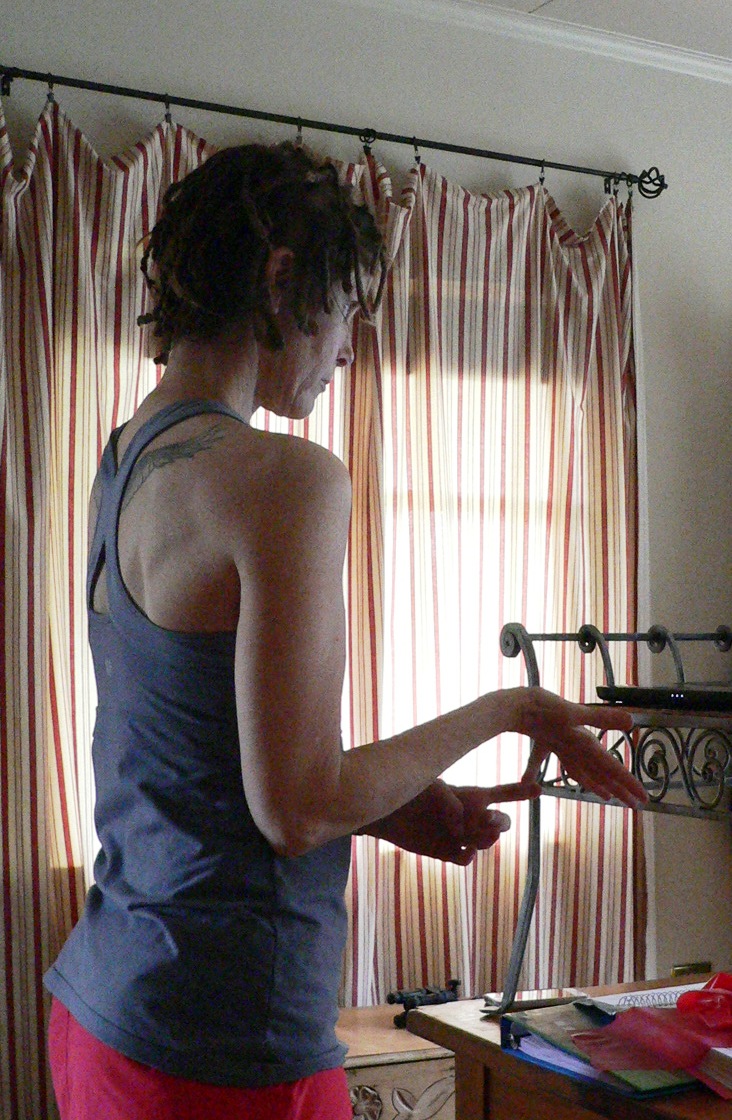
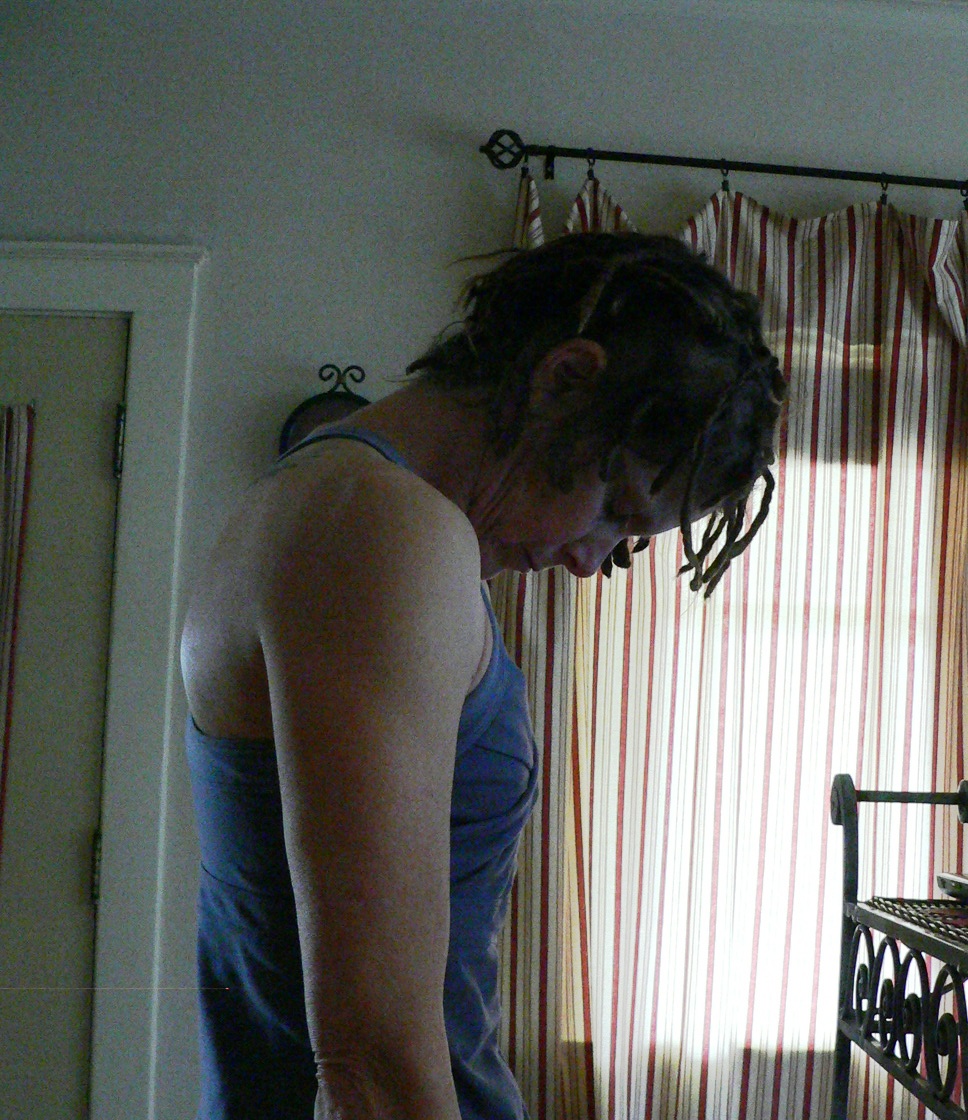
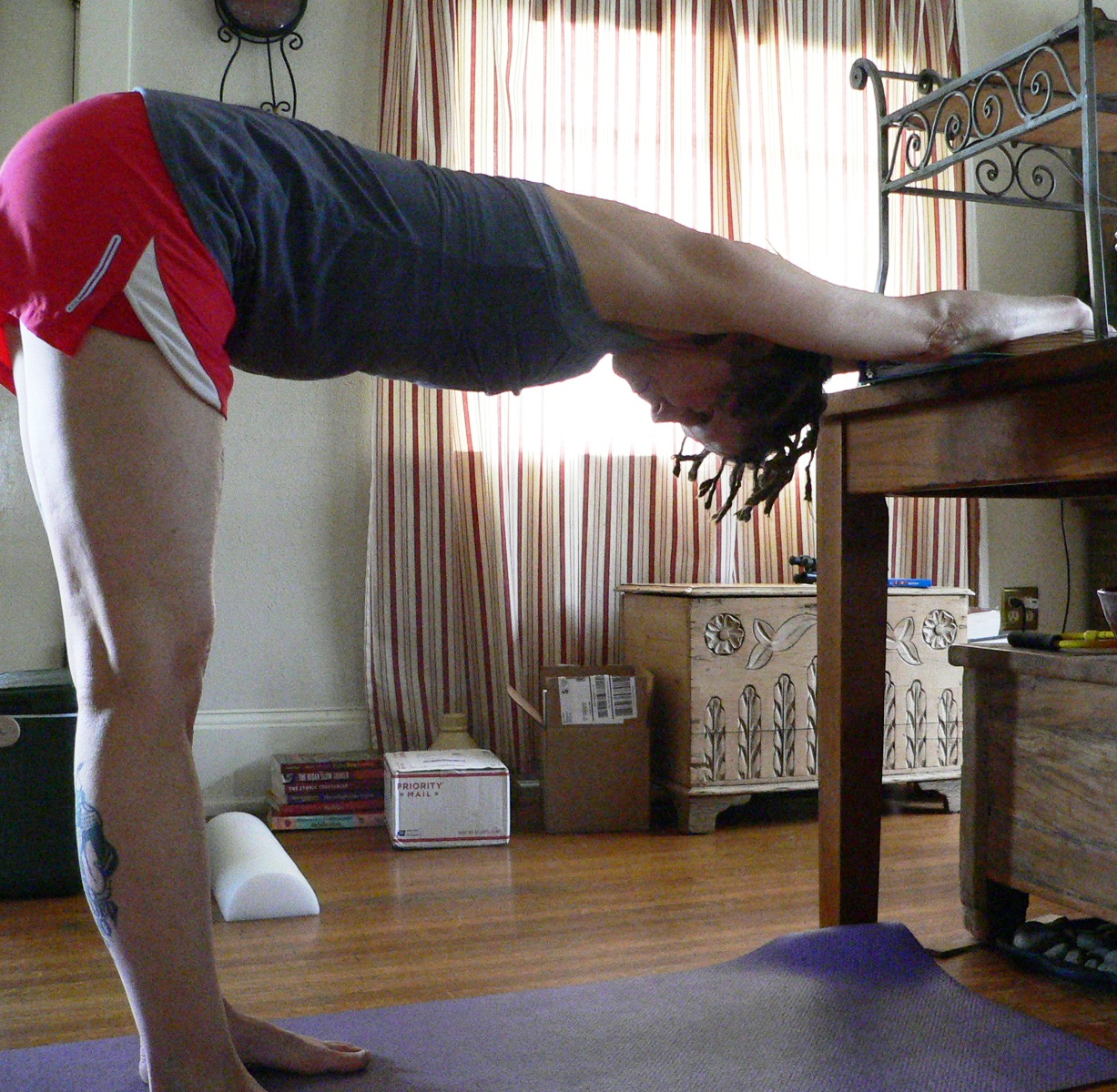
  • Head hang
  • Head hang

    Head hang

  • Three deep breaths – Stop what you are doing; allow your arms to hang by your sides; close your eyes and take three deep, chest expanding breaths
  • Arm swings – swing your arms forward and back. Let the work happen on the back swing and the ride happen on the forward swing. You can alternate arms to simulate a the arm swing that happens when you walk. Or, you could swing them forward and backward in sync. Try to keep your elbow pits (where you give blood) facing forward, but your hands facing your hips!
  • Alignment check – this is what I do each time I realize that I’ve zoned out and gotten too still (sedentary)
  • Squatting – I show a desk squat here; but you could do utkatasana or a full squat
  • squatdesk
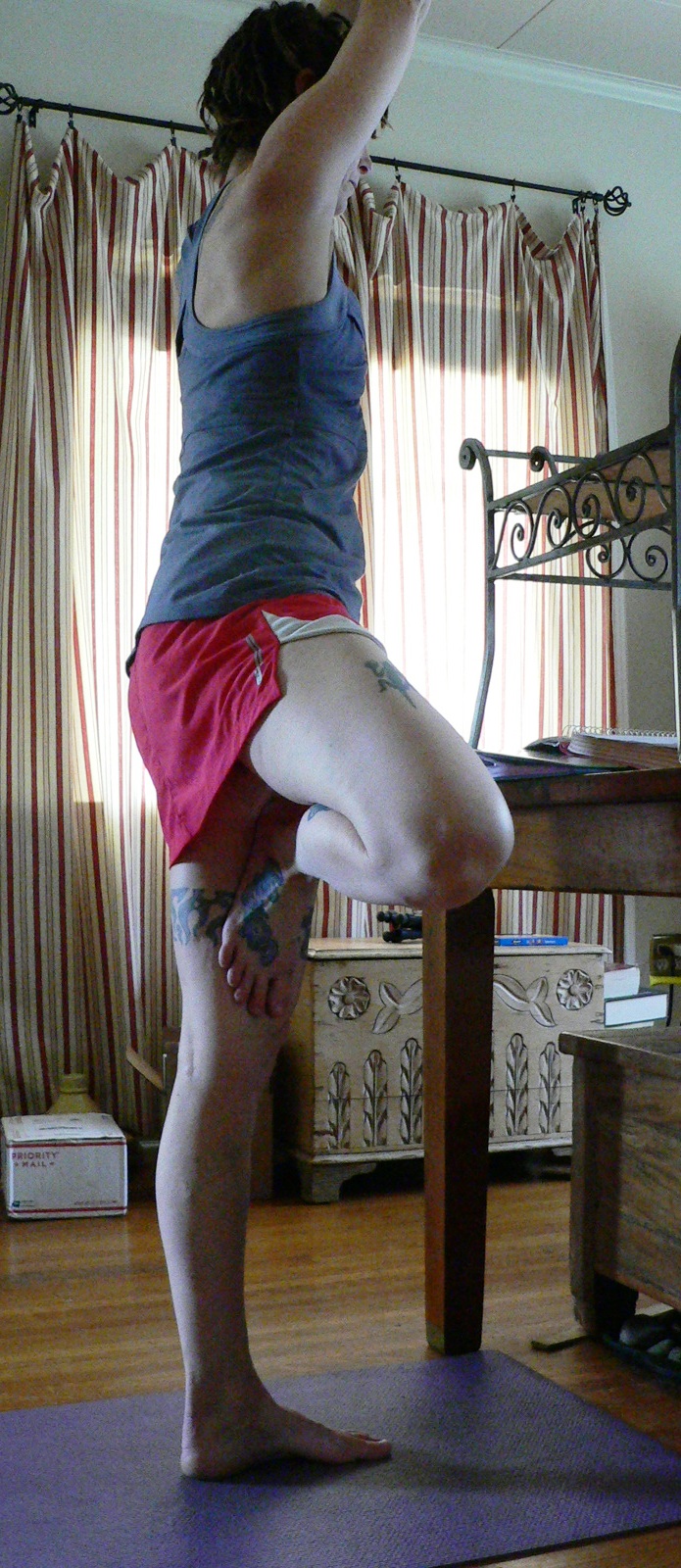
  • Single leg balances – any single leg balance will do. Try to keep your hips back and your quads relaxed
  • Vrksasana (tree pose)
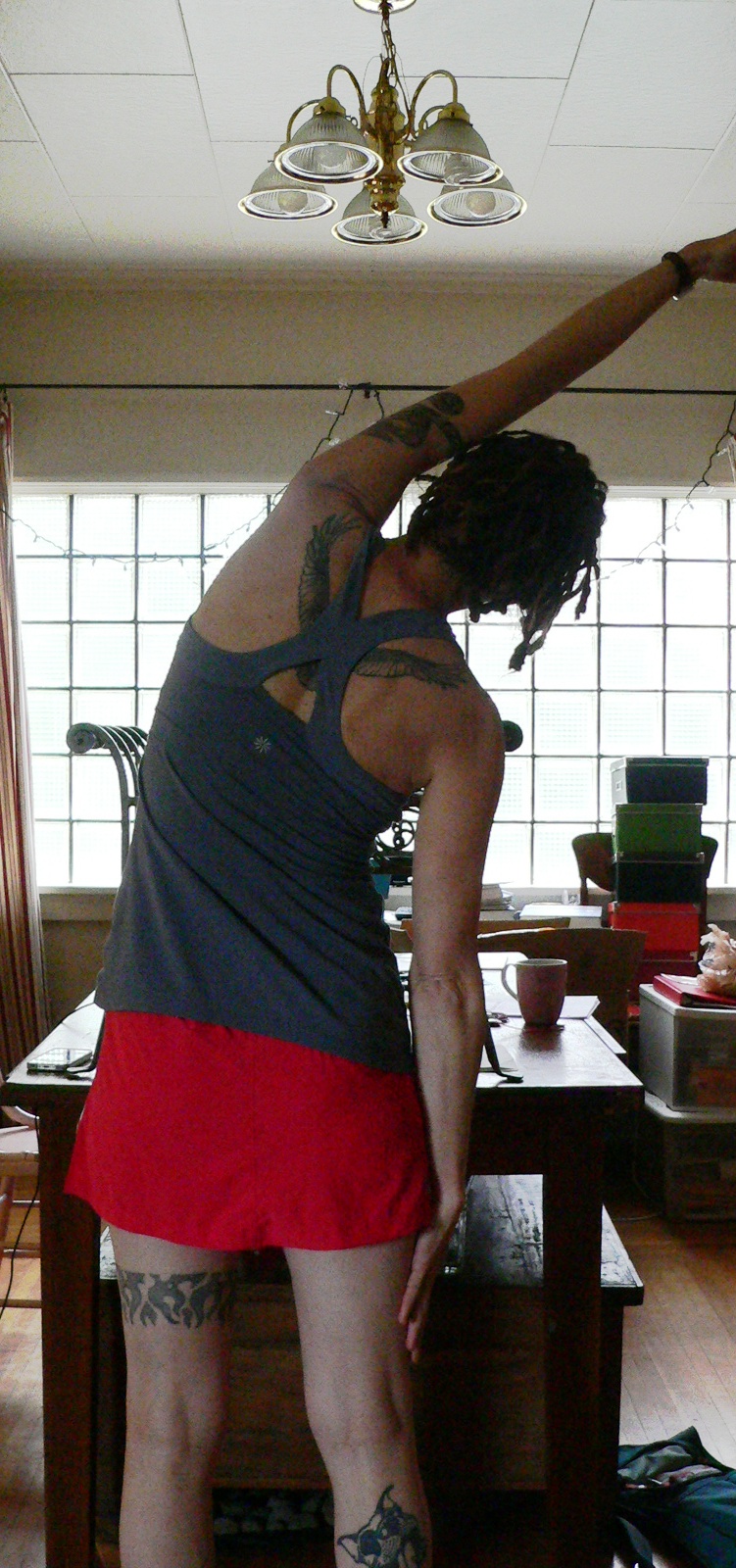
  • Lateral flexion
  • lateralflexdesk

    Lateral spinal flexion

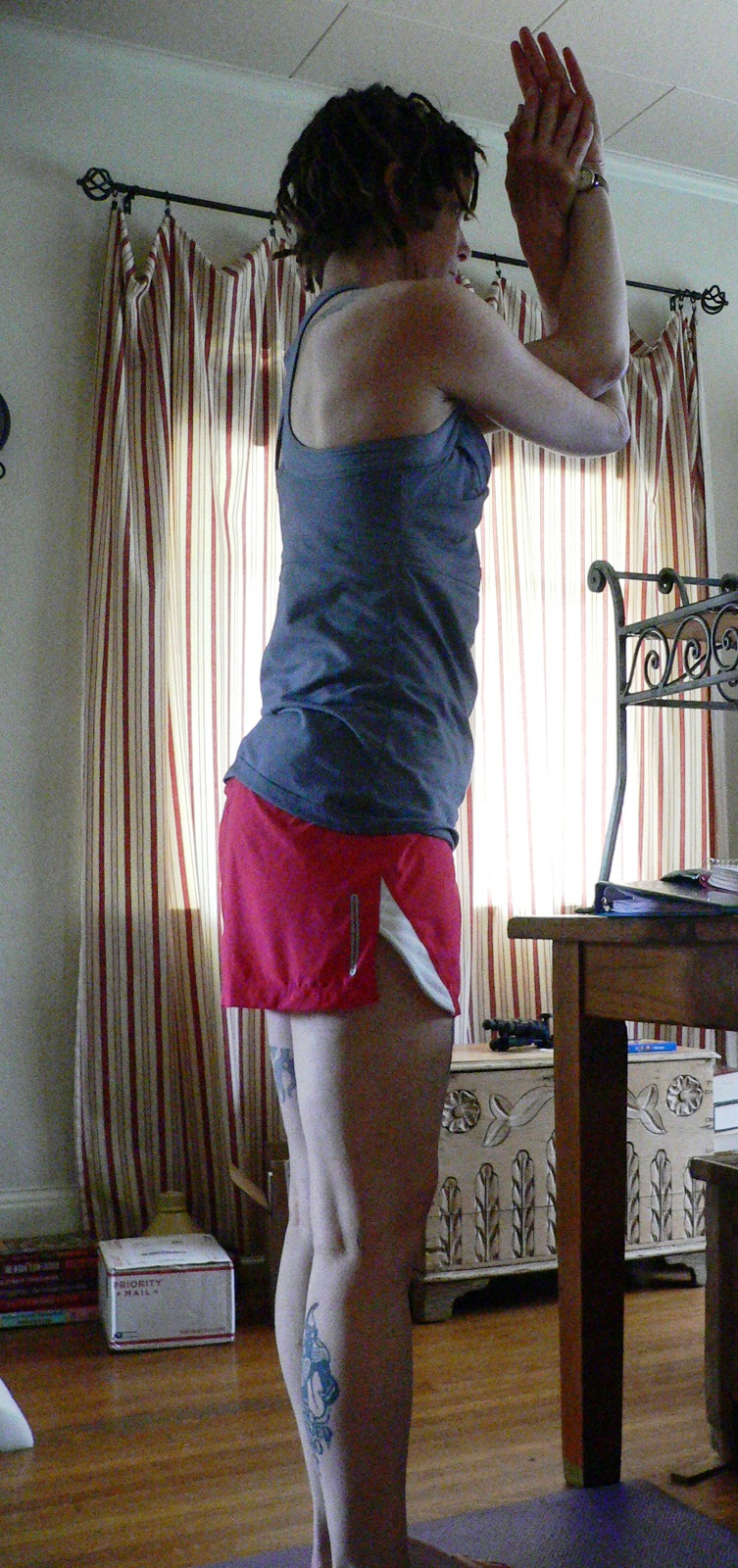
  • Garudasana arms
  • Garudasana (eagle) arms

    Garudasana (eagle) arms

  • Strong yoga foot 
  • Thoracic stretch
  • thoracicdesk

Don’t just stand there, keep moving!

Namaste, Michele